
EDUCATIONAL ACTIVITY PLAN
TOPIC: | Life below water: Coral reefs and ocean warming – protecting fragile marine habitats (SDG 14) |
CLASS / DURATION / PREPARED BY: | Grades 8–9; B1 level; 1 lesson (45 minutes); Prepared by: |
LEARNING TASK
After reading two B1-level informational texts, students explain why coral reefs are important, identify how ocean warming and marine heatwaves can cause coral bleaching, and use target vocabulary to discuss ways to protect reef ecosystems. In pairs, they create a short “Help the Reef Recover” plan with three realistic actions for communities, visitors, or decision-makers.
GOALS ACCORDING TO THE GENERAL CURRICULUM (2008)
General competences
- Learning to learn: students work purposefully with reading texts, vocabulary and comprehension tasks, compare answers, and reflect on strategies that help them understand scientific ideas in English.
- Cognitive: they identify cause-and-effect relationships, connect environmental changes with effects on coral reefs, and select suitable conservation measures.
- Social: they cooperate in pairs and groups, listen to different ideas, and agree on realistic actions that can help protect marine habitats and biodiversity.
- Personal: they take responsibility for their learning and consider how human choices can influence marine ecosystems and the future of coral reefs.
Subject competences
- Read B1-level informational texts and identify the main idea, specific details, and cause-and-effect relationships (English).
- Use target vocabulary (coral reef, bleaching, ocean warming, marine heatwave, habitat, biodiversity, recover, conservation) accurately in context (English).
- Explain in simple terms how heat stress can affect corals and why healthy reefs are important for marine life (Biology / Environmental science).
- Connect local conservation actions and wider climate-related choices with the protection of marine ecosystems (Citizenship / sustainability).
- Work collaboratively to produce and present a short “Help the Reef Recover” action plan using clear B1-level English (Communication).
Integration with other subjects
Biology / Environmental science (coral ecosystems and heat stress), Geography (warm seas and coastal regions), Civic education (shared responsibility for marine environments), ICT/Art (optional digital reef-awareness message).
MATERIALS / EQUIPMENT
Projector/interactive board, photos of healthy and bleached coral reefs, printed reading texts and worksheet (Appendices 1–2), vocabulary cards (optional), dictionaries or phones for quick word checks, paper or a digital template for the pair action plan.
LEARNING ACTIVITIES
(45-minute English lesson; B1 level; biology and environmental science links.)
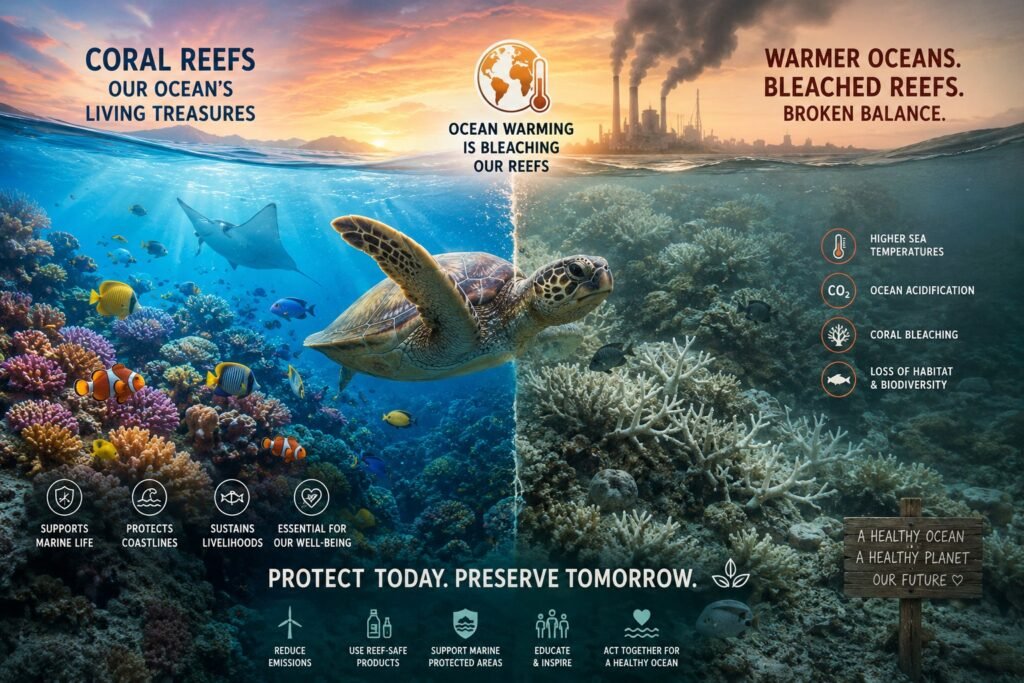
- Warm-up (5 min). Show two contrasting images: a colourful healthy coral reef and a pale bleached reef. Students answer: What differences can you see? Why might a reef lose its colour? Why could this matter for other sea animals?
- Pre-reading vocabulary (7 min). Students match the target words with definitions (Appendix 2, Task A). They compare answers in pairs and practise pronunciation.
- Reading & comprehension (17 min). Students read Text A and Text B in Appendix 1, underline causes, effects and solutions, and complete True/False and short-answer tasks (Appendix 2, Tasks B–C).
- Language focus (7 min). Students complete short cause-and-effect sentences using because, so and if (Appendix 2, Task D). Quick class check focuses on meaning and sentence structure.
- Speaking & action task (6 min). In pairs, students complete the “Help the Reef Recover” table (Appendix 2, Task E) and create three realistic actions for communities, visitors or decision-makers. They use at least four target words. A few pairs share one idea. Exit ticket + reflection (Appendix 3).
REFLECTION. ASSESSMENT
Reflection. Students complete their reflection by finishing the sentences:
- In this lesson I learned that coral reefs can be damaged when…
- One new word I can use correctly is…
- One action that can help a reef recover is…
- Today I did well when… / Next time I will try to…
APPENDIX 1
Reading texts: Coral reefs and ocean warming – protecting fragile marine habitats (SDG 14)
Text A – Why coral reefs matter
Coral reefs cover only a small part of the ocean, but they support a great variety of marine life. A coral reef is a living habitat built by tiny coral animals. Fish, crabs, sea turtles and many other organisms use reefs for food, shelter or breeding areas. Because so many species live there, coral reefs are important centres of biodiversity.
Reefs are also valuable to people. They can reduce the force of waves before they reach the coast, which helps protect beaches and coastal communities. They also support tourism and fishing in many regions. When a reef is damaged, both wildlife and people can lose important benefits.
Corals are sensitive to changes in their environment. They need suitable water temperature, light and water quality. Pollution, physical damage and rising sea temperatures can place corals under stress and make the whole habitat less healthy.
Table. Reef pressure, effects and protection measures
Reef situation / pressure | What can happen | Possible impact | Protection measure |
Long period of unusually warm water | Corals experience heat stress and may bleach. | Corals lose energy and become weaker. | Monitor reef temperature and reduce other local pressures. |
Repeated marine heatwaves | Bleached corals have less time to recover. | Some corals may die and reef structure can decline. | Support climate action and long-term reef conservation. |
Polluted coastal water | Nutrients, chemicals or sediment add extra stress. | Coral growth and recovery may slow. | Reduce pollution and improve wastewater management. |
Anchors or careless tourism | Corals can be broken or physically damaged. | Important habitat is lost. | Use mooring systems, marked routes and responsible visitor rules. |
Healthy protected reef | Local pressures are limited and habitats are managed. | Biodiversity and reef recovery may improve. | Create or respect marine protected and conservation areas. |
Poor public awareness | People may damage reefs without understanding the effects. | Local pressures continue unnecessarily. | Use education, signs and community conservation activities. |
Text B – What happens when the sea gets too warm?
Ocean warming means that average sea temperatures are rising over time. Sometimes the water also becomes unusually hot for days or weeks; this is called a marine heatwave. When corals experience too much heat stress, they can lose the tiny algae that normally live inside them and provide much of their colour and energy. The coral then becomes pale or white. This process is called bleaching.
Bleached coral is not always dead. If temperatures return to a safer level and other conditions are good, some corals can recover. However, long or repeated heat stress makes recovery more difficult and can lead to coral death. When large reef areas are damaged, fish and other animals may lose food and shelter.
Conservation can improve a reef’s chance of surviving and recovering. Local actions include reducing pollution, avoiding damage from anchors or careless tourism, protecting important reef areas, and monitoring reef health. Wider action to limit ocean warming is also important. Protecting coral reefs means reducing both local pressures and the causes of rising sea temperatures.
Read both texts and complete the vocabulary, comprehension, cause-and-effect and action tasks in Appendix 2.
APPENDIX 2
Student worksheet (English, B1)
- Task A – Vocabulary (match). Match the words to the definitions.
Words: coral reef, bleaching, ocean warming, marine heatwave, habitat, biodiversity, recover, conservation.
Definitions: a) the variety of living species in an area; b) a natural place where an organism lives; c) a period when sea temperatures are unusually high; d) long-term increase in ocean temperature; e) a living marine structure built by corals and used by many species; f) actions taken to protect nature and ecosystems; g) to become healthy or strong again after damage or stress; h) a stress response in which coral loses colour and becomes pale or white. - Task B – True / False. Read the texts again. Decide if the statements are True or False and correct the false ones.
1) Coral reefs provide food and shelter for many marine organisms.
2) Biodiversity means that only one species lives in an area.
3) A marine heatwave is a period of unusually warm sea temperature.
4) Bleached coral is always already dead.
5) Reducing pollution can support coral reef conservation. - Task C – Reading comprehension. Answer in complete B1-level sentences.
1) Why are coral reefs important for both marine animals and people?
2) What happens to corals during bleaching?
3) Under what conditions can some bleached corals recover?
4) Give two local conservation actions that can help protect coral reefs. - Task D – Cause and effect. Complete each sentence with because, so or if.
1) Coral reefs support high biodiversity ______ many species find food and shelter there.
2) Sea temperatures can become unusually high, ______ corals experience heat stress.
3) ______ the water cools again, some bleached corals may recover.
4) Reefs can become weaker ______ pollution and physical damage add extra stress.
5) People should reduce local pressures ______ reefs have a better chance to recover.
Task E – “Help the Reef Recover” action plan. Complete the table, then choose three actions that communities, visitors or decision-makers could realistically take.
Situation | What is the problem? | Target word to use | Better action |
A reef becomes pale after several very hot weeks. | Corals are under heat stress and may be bleaching. | bleaching / marine heatwave |
|
Tour boats sometimes drop anchors directly on coral. | Physical damage can destroy parts of the habitat. | coral reef / habitat / conservation |
|
Dirty water flows from the coast toward a reef. | Pollution adds stress and can slow recovery. | recover / biodiversity / conservation |
|
APPENDIX 3
Assessment criteria (10 points)
Explain the criteria to students before the tasks (what is expected and what each point represents).
- Reading comprehension (Tasks B–C) – up to 4 points.
- Vocabulary and language accuracy (Tasks A and D + use of target words in Task E) – up to 4 points.
- Pair action plan + participation + reflection/exit ticket – up to 2 points.