
EDUCATIONAL ACTIVITY PLAN
TOPIC: | Responsible consumption and production: Packaging and the circular economy – reduce, reuse, refill (SDG 12) |
CLASS / DURATION / PREPARED BY: | Grades 8–9; B1 level; 1 lesson (45 minutes); Prepared by: |
LEARNING TASK
After reading two B1-level informational texts, students explain how everyday packaging choices are connected with responsible consumption and production, identify why single-use packaging creates waste, and use target vocabulary to suggest realistic reduce, reuse, refill and recycling actions.
GOALS ACCORDING TO THE GENERAL CURRICULUM
General competences
- Learning to learn: students work purposefully with reading texts, vocabulary and comprehension tasks, compare answers, and reflect on strategies that help them understand sustainability ideas in English.
- Cognitive: they identify cause-and-effect relationships, connect packaging choices with resource use and waste, and select practical ways to keep materials in use for longer.
- Social: they cooperate in pairs and groups, listen to different ideas, and agree on realistic actions that support more responsible consumption.
- Personal: they take responsibility for their learning and consider how everyday choices about buying, reusing, refilling and sorting packaging can affect resources and waste.
Subject competences
- Read B1-level informational texts and identify the main idea, specific details, and cause-and-effect relationships (English).
- Use target vocabulary (packaging, single-use, reusable, refill, recycle, packaging waste, raw materials, circular economy) accurately in context (English).
- Explain in simple terms why packaging is used, how single-use packaging can become waste quickly, and how producing packaging requires raw materials and energy (Environmental science / Technology).
- Connect reducing packaging, choosing reusable items, refilling containers, sorting waste and recycling with responsible consumption and production (Citizenship / sustainability).
- Work collaboratively to produce and present a short “Packaging Check” action plan using clear B1-level English (Communication).
Integration with other subjects
Environmental science (materials, waste and resource use), Technology (product design and packaging), Geography (resources and transport), Civic education (responsible consumption and shared responsibility).
MATERIALS / EQUIPMENT
Projector/interactive board, photos of single-use and reusable packaging, printed reading texts and worksheet (Appendices 1–2), clean packaging samples (optional), vocabulary cards, dictionaries or phones/tablets for checking words.
LEARNING ACTIVITIES
(45-minute English lesson; B1 level; environmental science and sustainability links.)
- Warm-up (5 min). Show two contrasting images: a disposable drink bottle with several wrappers and a reusable bottle with a refill station. Students answer: Why do products need packaging? Which option creates less waste? Collect 3–4 ideas on the board.
- Pre-reading vocabulary (7 min). Students match the target words with definitions (Appendix 2, Task A). They compare answers in pairs and practise pronunciation.
- Reading & comprehension (17 min). Students read Text A and Text B in Appendix 1, underline problems, effects and responsible choices, and complete True/False and short-answer tasks (Appendix 2, Tasks B–C). Pair-check, then brief whole-class feedback.
- Language focus (7 min). Students complete short advice sentences using should, can and instead of (Appendix 2, Task D). Quick class check focuses on meaning and clear B1 sentence structure.
- Speaking & action task (6 min). In pairs, students complete the “Packaging Check” table (Appendix 2, Task E) and create three realistic actions for students, families or schools. They use at least four target words. Two or three pairs share one action.
REFLECTION. ASSESSMENT
Reflection (3 min). Students complete their reflection by finishing the sentences:
- In this lesson I learned that packaging can affect…
- One new word I can use correctly is…
- One action that can reduce packaging waste is…
- Today I did well when… / Next time I will try to…
APPENDIX 1
Reading texts: Responsible consumption and production – packaging and the circular economy: reduce, reuse, refill (SDG 12)
Text A – Why packaging becomes a problem
Packaging has useful purposes. It can protect food and other products, keep items clean, and make transport easier. However, many packages are designed for a very short life. Single-use packaging is normally used once and then thrown away. A bottle, cup, wrapper or container may be useful for only a few minutes, even though producing it required raw materials, energy and transport.
When large amounts of packaging are discarded, they become packaging waste. Some waste is collected for recycling, but not every material is easy to recycle, and mixed or dirty packaging may be difficult to process. If packaging is littered, it can also pollute streets, rivers and natural areas. Reducing unnecessary packaging before it becomes waste is therefore an important part of responsible consumption.
Table. Packaging situation, possible effect and responsible choice
Packaging situation / pressure | What can happen | Possible impact | Responsible choice |
A drink is sold in a new disposable bottle each time. | The bottle is used briefly. | More packaging waste is created. | Use a reusable bottle and refill it. |
A snack has several unnecessary wrappers. | More material is used. | More raw materials and waste are needed. | Choose a product with less packaging. |
A takeaway cup is used once. | It is thrown away quickly. | Single-use waste increases. | Bring a reusable cup when possible. |
Clean recyclable packaging is put in mixed rubbish. | Useful material is lost. | Less material returns to production. | Sort it correctly for recycling. |
A refillable container is replaced every time. | A new package is needed again. | Resource use increases. | Refill and reuse the same container. |
Packaging is difficult to reuse or recycle. | It quickly becomes waste. | More resources are needed for new packaging. | Choose or design simpler, recyclable packaging. |
Text B – From throw-away to circular choices
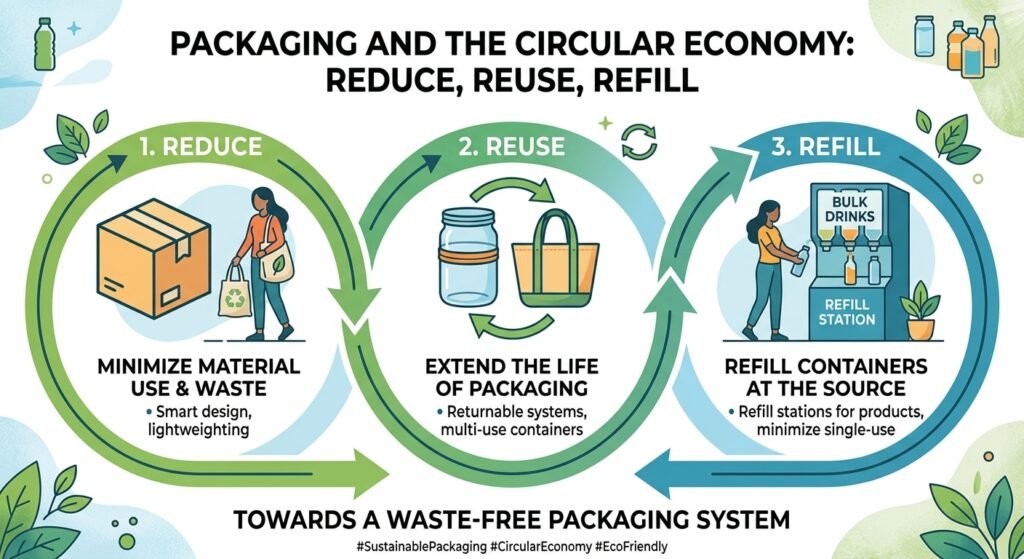
A circular economy aims to keep products and materials useful for as long as possible instead of using them once and throwing them away. For packaging, this can mean choosing a reusable bottle, lunch box or shopping bag. A refill option allows the same container to be used again instead of buying a new package every time.
Recycling also has an important role. People can sort suitable packaging correctly so that materials can be processed and used again. However, recycling works best together with reducing and reusing. Consumers can choose products with less packaging, use refill systems and reuse containers safely. Producers can design packaging that uses fewer raw materials and is easier to reuse or recycle. These actions help reduce packaging waste and support a more circular economy.
Read both texts and complete the vocabulary, comprehension, advice-language and action tasks in Appendix 2.
APPENDIX 2
Student worksheet (English, B1)
- Task A – Vocabulary (match). Match the words to the definitions.
Words: packaging, single-use, reusable, refill, recycle, packaging waste, raw materials, circular economy.
Definitions: a) materials from nature used to make products; b) a system that keeps products and materials in use for longer; c) material used to protect or contain a product; d) designed to be used only once; e) able to be used many times; f) to fill a container again; g) to process used material so it can be used again; h) discarded boxes, bottles, wrappers and other packaging. - Task B – True / False. Read the texts again. Decide if the statements are True or False and correct the false ones.
1) Packaging can protect products during storage and transport.
2) Single-use packaging is designed to be used many times.
3) Making packaging can require raw materials and energy.
4) Every type of packaging can be recycled easily and forever.
5) A circular economy tries to keep materials useful for longer.
6) Refill and reuse systems can reduce the need for new packaging. - Task C – Reading comprehension. Answer in complete B1-level sentences.
1) Give two useful purposes of packaging.
2) Why can single-use packaging create a lot of waste?
3) Why is recycling not the only solution to packaging waste?
4) Give three choices that support a circular economy. - Task D – Advice language. Complete each sentence with should, can or instead of.
1) We ______ choose a reusable bottle when possible.
2) Shops ______ offer refill options for some products.
3) Students can use a lunch box ______ several disposable wrappers.
4) People ______ sort recyclable packaging correctly.
5) Producers ______ design packaging that uses fewer raw materials.
Task E – “Packaging Check” action plan. Complete the table, then choose three actions that students, families or schools could realistically take.
Situation | What is the problem? | Target word to use | Better action |
A student buys a new plastic water bottle every school day. | A single-use item becomes waste after a short time. | single-use / reusable / refill |
|
A snack is packed in several separate wrappers. | More packaging and raw materials are used than necessary. | packaging / packaging waste / raw materials |
|
Clean cans and bottles are placed in the general waste bin. | Useful materials may not be recycled. | recycle / circular economy / packaging waste |
|
APPENDIX 3
Assessment criteria (10 points)
Explain the criteria to students before the tasks (what is expected and what each point represents).
- Reading comprehension (Tasks B–C) – up to 4 points.
- Vocabulary and language accuracy (Tasks A and D + use of target words in Task E) – up to 4 points.
- Pair action plan + participation + reflection/exit ticket – up to 2 points.