

EDUCATIONAL ACTIVITY PLAN
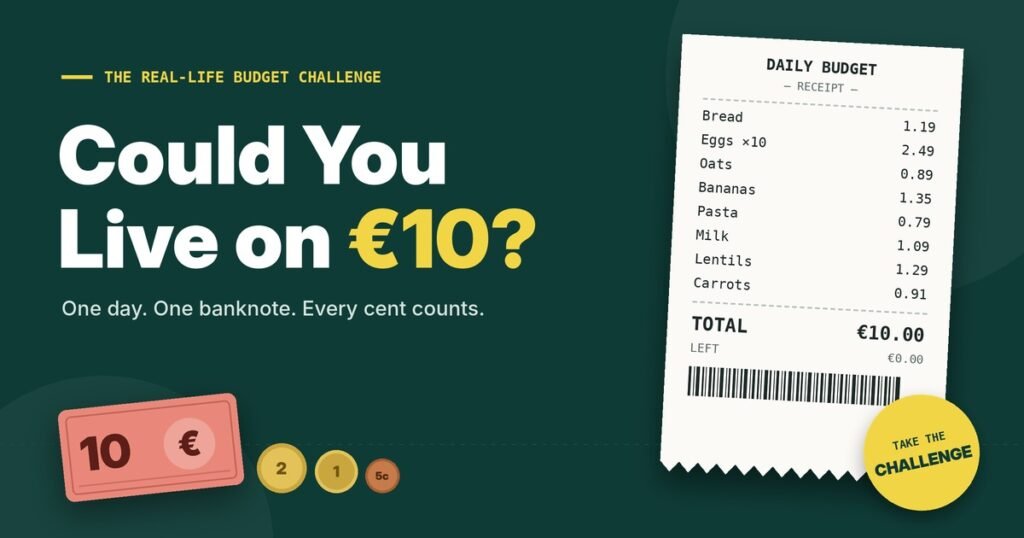
TOPIC: | Could You Live on €10? – The Real-Life Budget Challenge |
CLASS / DURATION / PREPARED BY: | Grades 8; 1 lesson; Prepared by: Zita Nichtová, English teacher, ZŠ ŠS Starý Tekov |
LEARNING TASK
Students take on the role of a family living on a very limited budget. They must decide how to spend their available money on essential needs, respond to an unexpected expense and suggest ways a community can support people experiencing financial difficulties.
GOALS ACCORDING TO THE GENERAL CURRICULUM
Students will:
- understand the difference between needs and wants;
- recognise that poverty can affect access to food, housing, education and healthcare;
- practise basic financial literacy and responsible decision-making;
- develop empathy and avoid judging people based on their financial situation;
- suggest practical, respectful ways to reduce poverty in their community.
General Competences
- Critical thinking and problem-solving
- Financial literacy
- Communication and collaboration
- Social and civic responsibility
- Empathy and respect for human dignity
Subject Competences
- English: discussing needs, expenses and solutions; presenting decisions and giving reasons.
- Mathematics: adding expenses, calculating remaining money and comparing costs.
- Civic Education: understanding social support, equal opportunities and community responsibility.
MATERIALS AND EQUIPMENT
Printed budget cards or worksheets, calculators or mobile phones, paper and pens, whiteboard.
LEARNING ACTIVITIES
Activity 1: Needs or Wants? ( 5 min. )
Display or read out these items: bread, rent, a winter jacket, mobile data, medicine, a cinema ticket, electricity and a new pair of trainers.
Students decide whether each item is a need, a want, or something that depends on the situation.
Discussion questions:
- What do we really need to live safely and with dignity?
- Can something that seems like a luxury be essential for someone else?
Key message: People’s needs differ, and we should not make assumptions about their circumstances.
Activity 2: The Family Budget Challenge ( 20 min. )
Students work in groups of three or four. Each group receives a fictional scenario:
Your family has €600 for essential expenses this month.
This is a simplified classroom simulation, not a typical real-life family budget.
Expense | Cost |
Rent and housing costs | €250 |
Food | €180 |
Electricity and heating | €60 |
Transport | €40 |
Medicines and hygiene | €30 |
School expenses | €20 |
Total | €580 |
Money left | €20 |
The challenge: The family has only €20 left. Then an unexpected expense appears: a necessary school item costs €15, or transport costs increase by €20.
Each group must decide what to do. They cannot simply ignore essential needs. They should consider practical options such as comparing prices, asking about available support, borrowing an item where appropriate or contacting a relevant service.
Ask groups to prepare three answers:
- What is the most difficult decision?
- What would you do first, and why?
- What support would make the biggest difference?
Useful English phrases:
- We would prioritise…
- We could save money by…
- We should ask for help from…
- Nobody should have to choose between…
Activity 3: Our Community Can Help ( 15 min. )
Each group becomes a small community action team. They design one realistic initiative that could help people experiencing financial difficulties in their school or community.
They may choose an idea such as:
- a school supplies exchange;
- a book and stationery sharing corner;
- a food collection organised with a local charity;
- a clothes or sports equipment swap;
- a campaign to reduce food waste and share suitable surplus through an appropriate organisation;
- a guide to local support services.
Each group completes this mini-plan:
Our Better Community Plan
- Problem: What need are we addressing?
- Action: What exactly will we do?
- Partners: Who could help us?
- Resources: What will we need?
- Impact: How will this help people?
Groups present their idea in one minute. Encourage solutions that protect people’s privacy and dignity, rather than singling anyone out.
Reflection and Exit Ticket ( 5 min. )
Each student completes three sentences:
- One thing I learned about poverty is…
- One thing our community could do is…
- Everyone deserves access to…
Finish with the message: Poverty is not a personal failure. Fair opportunities, support and community action can make a difference.
REFLECTION AND ASSESSMENT
Assess students through:
- participation in the budget challenge;
- sensible calculations and explanations;
- cooperation and respectful discussion;
- feasibility and social impact of the community action plan.
Expected learning outcome:
Students understand that reducing poverty involves more than donating money. It also means creating fair opportunities, supporting access to essential resources and treating everyone with dignity.
Lesson message: “Less Waste. More Sharing. Better Opportunities for All.”