

EDUCATIONAL ACTIVITY PLAN
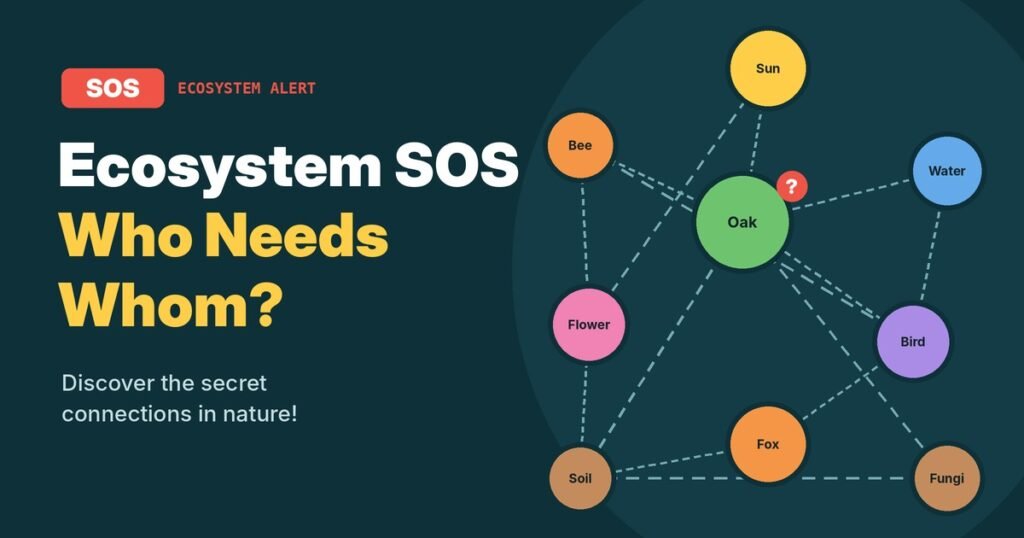
TOPIC: | Ecosystem SOS – Who Needs Whom? Discover the Secret Connections in Nature! |
CLASS / DURATION / PREPARED BY: | Grades 7- 9; 1 lesson; Prepared by: Zita Nichtová, English teacher, ZŠ ŠS Starý Tekov |
LEARNING TASK
Students become members of a living ecosystem. Through a movement game, a food-web challenge and a nature emergency simulation, they discover how plants, animals and other organisms depend on one another.
Working in teams, they investigate what happens when one species disappears and develop a simple plan to restore the balance of a damaged ecosystem.
The main question is: What happens to nature when one part of an ecosystem disappears?
GOALS ACCORDING TO THE GENERAL CURRICULUM
- To understand the relationships between organisms in an ecosystem.
- To explain the importance of biodiversity and balanced food webs.
- To identify how human activities can disturb natural ecosystems.
- To develop critical thinking, cooperation, communication and decision-making skills.
- To propose practical ways to protect and restore natural habitats.
- To encourage responsible behaviour towards plants, animals and the local environment.
General competences
- Students describe organisms, explain ecological relationships and present solutions in English.
- Students collaborate in teams, share information, listen to others and make joint decisions.
- Students analyse changes in an ecosystem, predict consequences and suggest actions to protect biodiversity.
Subject competences
- Students use vocabulary related to ecosystems, food chains, habitats and wildlife. They formulate simple explanations using phrases such as depends on, because of, if… then… and we should….
- Students identify producers, consumers and decomposers, construct simple food chains and explain relationships between organisms.
- Students complete an interactive quiz or create a digital food web or ecosystem-protection poster using an available educational tool.
Integration with other subjects
- English: Vocabulary, discussion and short presentations.
- Biology: Food chains, food webs, biodiversity and ecosystems.
- Geography: Forests, meadows, rivers and local habitats.
- Informatics: Digital quizzes and visual representations of food webs.
- Mathematics: Counting species and interpreting simple changes in numbers.
MATERIALS / EQUIPMENT
Organism cards: plants, animals, fungi and other organisms, a ball of string or wool, paper, markers and sticky notes, prepared ecosystem emergency cards, whiteboard and timer, optional smartphones, tablets or computers, optional Kahoot, Wordwall or LearningApps.
LEARNING ACTIVITIES
Activity 1: Nature in Three Words ( 5 min.)
The teacher writes three words on the board: PLANT – ANIMAL – HUMAN.
Students have one minute to think about how these three are connected. They then share their ideas with a partner.
The teacher asks:
- Can animals survive without plants?
- Why do plants need other organisms?
- What might happen if all insects disappeared?
Students make predictions. The teacher introduces the idea that organisms are connected and that changes affecting one species can influence many others.
Activity 2: Build a Living Food Web ( 12 min.)
Students receive organism cards and stand in a circle. Possible roles include grass, oak tree, caterpillar, rabbit, mouse, frog, snake, fox, owl, mushroom and earthworm.
The teacher gives a ball of string to one student. That student passes it to another organism that is connected to theirs, while explaining the relationship.
Examples:
- Grass provides food for the rabbit.
- The caterpillar eats plant leaves.
- The frog eats insects.
- The fox may eat rabbits or mice.
- Fungi and earthworms help break down organic matter and recycle nutrients.
Students continue passing the string until a web of connections forms across the circle.
The teacher asks students to observe the web:
- How many connections can you see?
- Which organisms have several connections?
- What could happen if one organism disappeared?
Students discover that an ecosystem is more complex than a single food chain.
Safety note: Students pass the string gently and keep it loose, without wrapping it around their bodies.
Activity 3: Ecosystem Emergency! ( 10 min. )
The teacher announces a fictional environmental emergency. Students holding the affected organism cards lower their hands or gently release their part of the string. The class observes which connections are affected.
Teams receive one emergency card each.
Emergency A – The Disappearing Insects
A meadow is treated with chemicals that greatly reduce insect populations.
Questions:
- Which animals may have less food?
- What might happen to pollination?
- How could the meadow be protected?
Emergency B – The Forest Is Cut Down
A large area of forest is cleared.
Questions:
- Which organisms lose their habitats?
- What happens to food and shelter?
- What could help restore the forest?
Emergency C – The Missing Predators
The number of predators in an ecosystem decreases significantly.
Questions:
- Which prey populations might increase?
- Could this affect plants?
- Why is biodiversity important for ecosystem balance?
Each team has two minutes to discuss its scenario and shares one consequence and one possible solution.
The teacher emphasises that real ecosystems are complex, so outcomes depend on the species and environmental conditions involved.
Activity 4: Save the Ecosystem Challenge ( 12 min.)
Teams become ecosystem rescue experts. Each team chooses one damaged habitat: a forest, a meadow or a pond.
They have eight minutes to design a simple Ecosystem Rescue Plan containing:
- One major problem.
- Two organisms affected by the problem.
- Three practical actions to improve the habitat.
- A short English slogan.
Example: Save Our Meadow!
- Problem: Too few flowering plants and pollinators.
- Affected organisms: Bees and flowering plants.
- Actions:
- Plant suitable native flowers.
- Reduce unnecessary mowing in selected areas.
- Avoid disturbing wildlife and its habitat.
- Slogan: “Let Nature Bloom!”
Teams may draw their plan on paper or create a simple digital poster. They should focus on realistic actions that could be taken at school or in the local community.
The teacher then gives each team up to one minute to present its strongest idea.
Activity 5: The Final Nature Quiz ( 6 min.)
Students answer a quick quiz individually or in teams using Kahoot, Wordwall or answer cards.
Question 1: What is a food web?
- A group of unrelated animals.
- A network of connected food chains.
- A place where spiders live.
Correct answer: B.
Question 2: What is the role of decomposers?
- They help break down dead organic matter and recycle nutrients.
- They stop all plants from growing.
- They produce all the sunlight.
Correct answer: A.
Question 3: Why can the disappearance of one species affect others?
- Organisms can depend on one another for food or other ecological relationships.
- Every species lives completely independently.
- Only humans depend on nature.
Correct answer: A.
To finish, students complete the sentence:
“One thing I can do to help protect biodiversity is…”
REFLECTION and ASSESSMENT
Assessment methods
- Teacher observation during the food-web activity.
- Answers and explanations during the ecosystem emergency challenge.
- Assessment of the Ecosystem Rescue Plan.
- Participation in the final quiz.
- Individual reflection at the end of the lesson.
Assessment criteria
Criteria | Expected achievement |
Scientific understanding | Explains at least one relationship between organisms. |
Environmental awareness | Identifies a threat to an ecosystem. |
Problem-solving | Suggests practical actions to protect a habitat. |
Communication | Explains ideas in understandable English. |
Cooperation | Contributes to team activities and respects others. |
Reflection | Identifies one personal action to support biodiversity. |
Student self-assessment: Students rate themselves from 1 (not yet) to 5 (very well).
- I can explain what a food web is.
- I understand how organisms depend on one another.
- I can predict one possible consequence of an environmental change.
- I can suggest ways to protect a natural habitat.
- I contributed to my team’s work.
Expected Learning Outcomes
By the end of the 45-minute lesson, students will be able to:
- Construct or explain a simple food web.
- Identify at least two possible consequences of an ecosystem disturbance.
- Explain why biodiversity matters.
- Develop a practical plan to protect a forest, meadow or pond.
- Present environmental solutions in simple English.
Final message: “Every species matters. Every connection counts. Protect the web of life!”