
EDUCATIONAL ACTIVITY PLAN
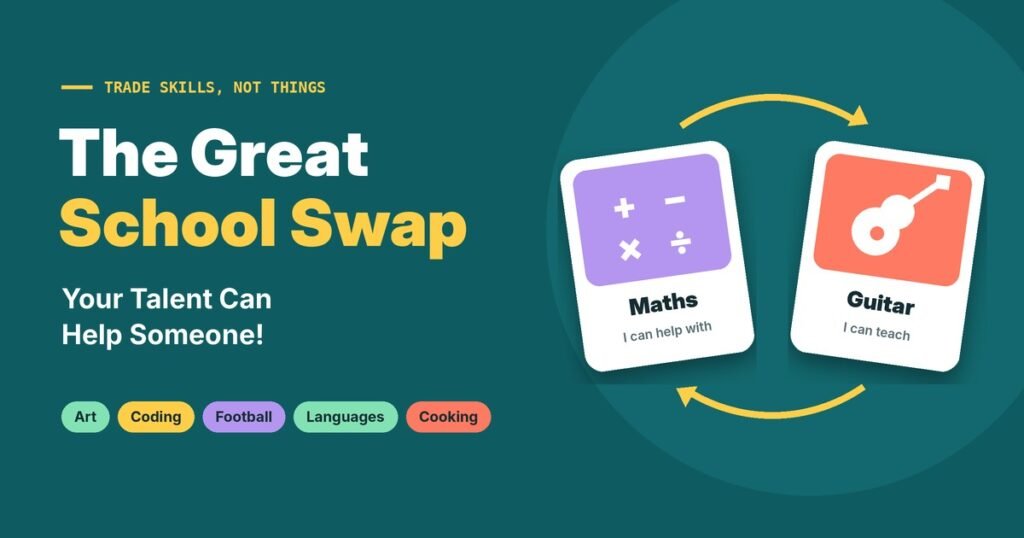
TOPIC: | The Great School Swap – Your Talent Can Help Someone! |
CLASS / DURATION / PREPARED BY: | Grades 7 – 9; 1 lesson; Prepared by: Zita Nichtová, English teacher, ZŠ ŠS Starý Tekov |
LEARNING TASK
Students discover that everyone has something valuable to offer. They take part in a creative skill-sharing challenge, identify what their school community needs and design a mini-event where people can learn from one another.
The central message is that a strong community is not made up of people who can do everything, but of people who are willing to share what they know.
GOALS ACCORDING TO THE GENERAL CURRICULUM
- Understand how sharing knowledge and skills strengthens partnerships.
- Recognise and appreciate different abilities and contributions.
- Develop creativity, communication and teamwork.
- Plan a simple collaborative activity that benefits others.
General Competences
- Social competence: Appreciate the abilities of others and offer support.
- Communication: Explain ideas, ask questions and share knowledge.
- Initiative and cooperation: Organise a shared activity and contribute to a common goal.
Subject Competences
- Use English vocabulary related to skills, talents, cooperation and learning.
- Describe personal skills and identify ways to help others.
- Plan and present a practical skill-sharing activity in English.
Integration with Other Subjects
- Civic Education: Community involvement and mutual support.
- Ethics: Respect, inclusion and appreciation of others.
- Informatics: Sharing useful digital knowledge safely.
- English: Describing abilities, giving instructions and making suggestions.
MATERIALS AND EQUIPMENT
Paper and pens, sticky notes, board or interactive whiteboard, optional: everyday classroom objects for demonstrations
LEARNING ACTIVITIES
Activity 1 – Everyone Has Something to Offer ( 10 min. )
Tell students that they are preparing for a special event where nobody is allowed to say, “I have nothing to teach!”
Ask them to think of one thing they can teach someone in five minutes. It does not need to be an academic skill.
Examples:
- A useful English expression.
- How to draw a simple cartoon.
- How to make an origami figure.
- A football trick or dance step.
- How to organise school notes.
- A keyboard shortcut or a useful digital tool.
- How to make a simple snack safely.
- A local tradition, craft or practical skill.
Each student writes their skill on a sticky note. Students place the notes on the board under the heading “Our Class Has Talent!”
Discuss:
- Are all useful skills taught at school?
- Can someone who struggles with a school subject still teach others something valuable?
- What happens when we share our knowledge?
Useful English:
- “I can teach others how to…”
- “I would like to learn…”
- “This skill is useful because…”
Key message: Everyone can contribute something, and everyone can learn something.
Activity 2 – The Skill-Sharing Challenge ( 20 min. )
Put students into groups of four or five. Each group receives this challenge:
“Design a 30-minute Skill-Sharing Festival for your school. The festival must help pupils learn something useful from one another and involve at least two different groups of people.”
Groups choose three mini-workshops from their classmates’ skills or invent new ones.
They must decide:
- Who teaches? Which students or other people can share their skills?
- Who learns? Which pupils or community members could benefit?
- What happens? What will participants actually do?
- Who are our partners? Could teachers, parents, older people, a local library, a sports club or local craftspeople help?
- How can everyone participate? How will they include students with different interests and abilities?
Example festival programme:
Workshop | What participants learn | Possible partner |
English in 5 Minutes | Everyday English phrases | English pupils or teachers |
Create Something New | A simple craft or drawing | Local craftsperson |
Smart Digital Tricks | Useful digital skills | Older pupils or an ICT teacher |
Move and Play | A new game or sports skill | Sports club |
Stories from Our Village | Local stories and traditions | Grandparents or local residents |
Groups prepare a simple programme and a short invitation to their festival.
Useful English:
- “We could invite…”
- “Participants will learn how to…”
- “Our partnership would help because…”
- “Everyone can take part by…”
Teacher’s tip: Remind students that the goal is not to organise the biggest event. The best plan is one that is realistic, welcoming and genuinely useful.
Activity 3 – The Invitation That Brings Us Together ( 15 min. )
Each group has two minutes to present its festival idea. The rest of the class listens and chooses one workshop they would most like to attend.
After the presentations, students create a short invitation in English. It must include:
- The name of the event.
- Who is invited.
- What people can learn.
- How people can contribute.
- Why sharing skills matters.
Example:
Welcome to our Better Together Skill Festival!
Come and learn something new from your classmates, teachers and community. Share your talents, discover new interests and help others develop their skills. Everyone has something to offer, and everyone is welcome!
Finish by asking each student to complete two sentences:
“One skill I can share is…”
“One skill I would love to learn from someone else is…”
Collect their answers to identify opportunities for a real school activity.
REFLECTION AND ASSESSMENT
Assess students through their participation, cooperation, creativity and ability to explain how their proposed festival benefits others.
Reflection questions:
- Why is sharing knowledge a form of partnership?
- How can people with different skills help each other?
- What could prevent someone from participating, and how could we remove that barrier?
Expected Learning Outcomes
By the end of the lesson, students will be able to:
- Identify skills that they and others can share.
- Explain the value of cooperation and mutual learning.
- Design a simple skill-sharing event involving different partners.
- Create an invitation that encourages participation and inclusion.
Final slogan: “Share What You Know. Learn What You Don’t. Grow Together!”