

EDUCATIONAL ACTIVITY PLAN
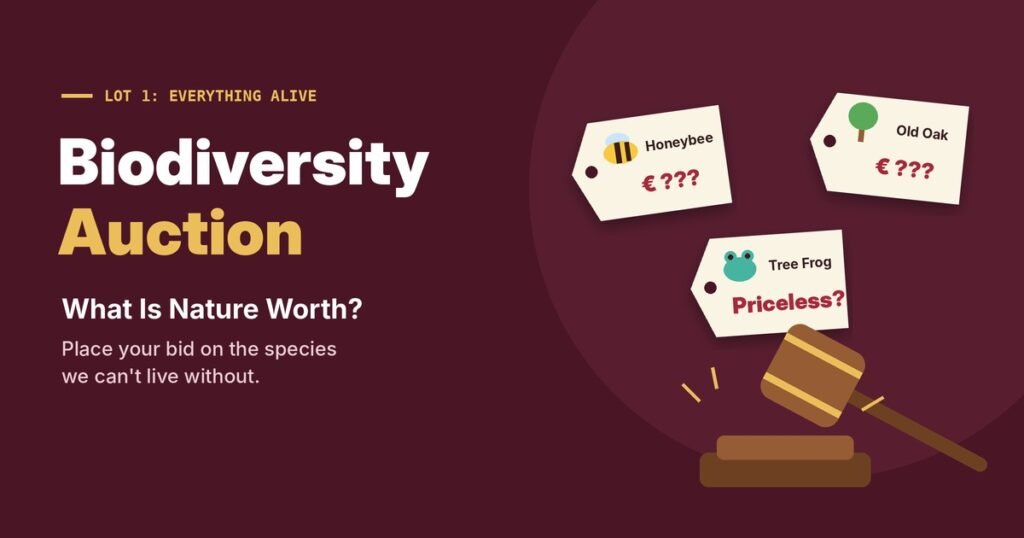
TOPIC: | Biodiversity Auction – What Is Nature Worth? |
CLASS / DURATION / PREPARED BY: | Grades 8; 1 lesson; Prepared by: Zita Nichtová, English teacher, ZŠ ŠS Starý Tekov |
LEARNING TASK
Students take part in a simulated auction where they must decide which natural habitats and species to protect with a limited budget. They discover why biodiversity matters and how human decisions influence life on land.
Students work in teams as environmental organisations. They receive a limited number of eco-coins and bid on habitats, species and conservation projects. They must justify their choices in English and create a short action plan to protect biodiversity in their local area.
GOALS ACCORDING TO THE GENERAL CURRICULUM
- Develop environmental awareness and responsible decision-making.
- Understand the importance of biodiversity and healthy ecosystems.
- Develop critical thinking, problem-solving and collaboration.
- Communicate opinions and arguments in English.
General Competences
- Communication: Express opinions and explain decisions in English.
- Critical thinking: Compare options, evaluate consequences and make informed choices.
- Cooperation: Work in a team, negotiate and agree on a shared solution.
Subject Competences
- Identify examples of biodiversity, habitats and threats to wildlife.
- Use vocabulary related to nature conservation and sustainability.
- Present and defend a conservation decision using simple arguments.
Integration with Other Subjects
- Biology: Ecosystems, species, habitats and biodiversity.
- Geography: Local landscapes and human impact on the environment.
- Mathematics: Managing a budget and comparing costs.
- Civic Education: Responsibility, decision-making and community action.
MATERIALS AND EQUIPMENT
Habitat and conservation-project cards, paper eco-coins or points, team worksheets, board or interactive whiteboard, pens and sticky notes
LEARNING ACTIVITIES
Activity 1 – What Would You Save? ( 5 min. )
Show students these choices: a forest, a meadow, a wetland, a butterfly, a hedgehog or an old tree. Ask:
- Which would you protect first?
- Why is biodiversity important?
- Can one species affect other living things?
Introduce the key question: What is nature worth?
Activity 2 – Meet the Auction Items ( 8 min. )
Divide students into teams. Give each team a budget of 100 eco-coins and introduce the items below.
Auction item | Price | ||
Protect a small forest | 40 | ||
Restore a wildflower meadow | 25 | ||
Create a pond for wildlife | 30 | ||
Plant native trees | 15 | ||
Protect a hedgehog habitat | 15 | ||
Create a butterfly-friendly garden | 10 | ||
Explain that the prices are fictional and that every option offers a different conservation benefit.
Activity 3 – The Biodiversity Auction ( 12 min. )
The teacher acts as the auctioneer. Teams bid for the conservation projects they want to fund. They must stay within their 100-coin budget.
Before each bid, teams give a reason in English:
- “We choose the forest because it provides habitats for many species.”
- “We want to restore the meadow because pollinators need flowers.”
- “We should plant native trees because they support local wildlife.”
Teams record their purchases and calculate their remaining budget.
Activity 4 – Defend Your Decisions ( 12 min. )
Each team prepares a short presentation explaining:
- What did you buy?
- Why did you choose these projects?
- Which animals or plants could benefit?
- What did you have to leave out, and why?
Each team presents for approximately one minute. Other students may ask one question.
Activity 5 – From the Auction to Real Life ( 8 min. )
Each student completes the sentence:
“One thing we can do at our school or in our village to protect life on land is…”
Students share their ideas and vote for one realistic class action, such as creating a small wildlife-friendly corner, planting native flowers or protecting an existing habitat.
REFLECTION AND ASSESSMENT
Use an exit ticket. Students answer three short questions:
- What does biodiversity mean?
- Why is it important to protect habitats?
- What is one action you can take to protect local nature?
Assessment criteria:
- Correct understanding of biodiversity and habitats.
- Ability to give at least one reason for a conservation choice.
- Active participation and cooperation.
- A realistic idea for protecting nature.
Expected Learning Outcomes
By the end of the lesson, students will be able to:
- Explain the importance of biodiversity in simple English.
- Identify several ways to protect habitats and species.
- Justify a conservation decision using evidence and arguments.
- Propose one practical action to support local biodiversity.
Final slogan: “Every Species Matters – Invest in Nature!”