
EDUCATIONAL ACTIVITY PLAN – SDG 8
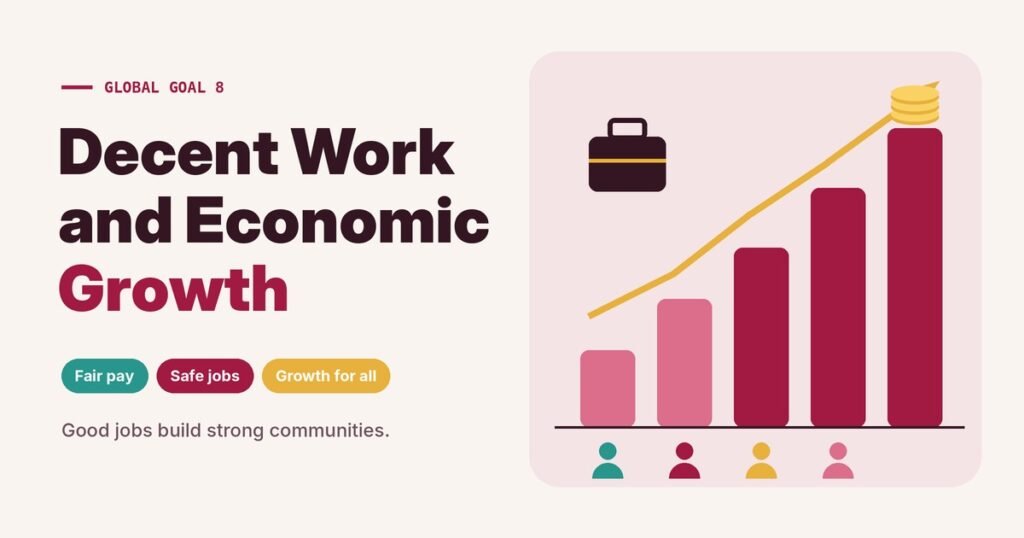
TOPIC: | Decent work and economic growth |
CLASS / DURATION / PREPARED BY: | Grades 8–9; 2 lessons , Prepared by: Ivana |
LEARNING TASK
Working in groups, students will explore the concept of decent work and economic growth, analyze data and real-life situations related to employment and working conditions, and design awareness activities promoting fair work opportunities and sustainable economic development.
GOALS ACCORDING TO THE GENERAL CURRICULUM
General Competences
Learning to Learn Students actively engage in the learning process, critically evaluate new information about employment and economic development, and identify areas where further learning is needed.
Cognitive Competence Students analyze examples, statistical data, and real-life situations related to decent work, employment, and economic growth, identify causes and consequences, and develop critical thinking skills.
Social Competence Students practice cooperation, respectful communication, and active listening while working together to solve problems and share ideas.
Personal Competence Students develop responsibility, understand the importance of workers’ rights and fairness, and build confidence in expressing their opinions and values.
Subject Competences
- Recognize and explain the concepts of decent work and economic growth.
- Identify factors influencing the quality of working conditions.
- Analyze simple statistical data or case studies related to employment and work environments.
- Express and justify personal opinions on workers’ rights, employment, and economic development.
- Design awareness-raising actions promoting fair working conditions, employment opportunities, and responsible business practices.
Integration with Other Subjects
Geography, Mathematics, Language Arts, Civics, Ethics.
MATERIALS / EQUIPMENT
Data charts, worksheets, internet access or printed materials, paper, markers, video (optional).
LEARNING ACTIVITIES
Announcement of the Learning Task
The teacher introduces the topic of decent work and economic growth and explains that students will explore the importance of quality jobs, employment opportunities, and economic development for society.
Establishing Discussion Rules
The class agrees on rules for respectful communication, active listening, and constructive discussion.
Introduction to Key Concepts
Students are introduced to the concepts of:
- decent work,
- workers’ rights,
- safe working conditions,
- employment,
- productivity,
- economic growth,
- sustainable development.
These concepts are presented through examples, short texts, or images.
Group Exploration of Real-Life Situations
Students work in groups to examine case studies, scenarios, or simple statistical data related to:
- youth unemployment,
- workplace safety,
- fair wages,
- employment opportunities,
- the relationship between education and employment.
Awareness-Action Design
Each group designs an awareness activity (poster, slogan, campaign, school event, or short presentation) promoting decent work and sustainable economic growth.
Sharing and Reflection
Groups present their work. A guided class discussion follows on the importance of workers’ rights, employment opportunities, and the role of individuals in building a fair and sustainable society.
REFLECTION. ASSESSMENT
Students reflect on learning outcomes and teamwork.
Assessment is based on:
- participation,
- accuracy and quality of information,
- creativity of proposed solutions and awareness activities.
APPENDIX 1 – Decent Work and Economic Growth Overview
Decent Work and Economic Growth refers to creating employment opportunities that provide fair wages, safe working conditions, and opportunities for personal development while supporting sustainable economic development.
Key Concepts:
- decent work,
- workers’ rights,
- workplace safety,
- fair wages,
- employment,
- economic growth,
- productivity,
- sustainable development.
APPENDIX 2 – Work Procedure
- Students review short texts, images, or simple statistical data related to decent work and economic growth.
- Students identify examples of quality working conditions and workplace challenges.
- Students create a poster or short presentation promoting decent work and responsible economic development.
- Students propose an awareness-raising activity encouraging fair employment opportunities and sustainable growth.
APPENDIX 3 – Assessment Criteria
- Teamwork and respectful cooperation (3 points)
- Accuracy and clarity of the poster/presentation and proposed solutions (4 points)
- Active participation and contribution to discussion (3 points)
Decent Work and Economic Growth – key terms SDG 8 – add key terms
SDG 8 Problems/Solutions
EDUCATIONAL ACTIVITY PLAN – SDG 8
TOPIC: | Human Body and Health: Occupational Health and Safety |
CLASS / DURATION / PREPARED BY: | Grades 8–9; 45 – minutes , Prepared by: Ivana |
LEARNING TASK
Students identify workplace health risks, propose protective measures, and explain the importance of occupational health and safety for individuals and society.
GENERAL COMPETENCES
Students:
- think critically and solve problems,
- communicate and argue their ideas,
- cooperate effectively in groups,
- apply knowledge to everyday situations,
- act responsibly.
Subject Competencies (Biology)
Students:
- explain relationships between health, environment, and lifestyle,
- identify health risk factors,
- propose health protection measures,
- evaluate consequences of unsafe behaviour.
LEARNING ACTIVITIES
Activity 1: Risks Around Us (10 min)
Method: Brainstorming and discussion
Students examine pictures of different workplaces:
- construction site,
- laboratory,
- office,
Questions:
- What dangers can you see?
- What accidents may occur?
- How can these risks be prevented?
Activity 2: Safety Detectives (15 min)
Group Work
Students analyse workplace scenarios.
Scenario A
A construction worker works without a helmet.
Scenario B
A laboratory technician handles chemicals without gloves.
Scenario C
An office worker spends all day sitting incorrectly at a computer.
Task
- Identify the risk.
- Explain possible consequences.
- Suggest preventive measures.
- Present your solution.
Activity 3: Design a Safe Workplace (15 min)
Pair Work
Students choose a profession:
- healthcare worker,
- builder,
- cook,
- laboratory technician,
Task: Describe or draw:
- workplace environment,
- possible risks,
- protective equipment,
- safety rules.
Output: Short presentation.
Reflection (3 min)
Traffic Light Reflection
🟢 What did I learn today? 🟡 What surprised me? 🔴 What do I still need help with?
Assessment (2 min)
Formative Assessment
Criteria:
- active participation,
- identification of hazards,
- teamwork,
- proposed safety measures,
- presentation quality.
Self-Assessment
“Today I learned that…”
Appendix 1 – Worksheet
Situation | Hazard | Consequence | Prevention |
Working without a helmet |
|
|
|
Chemicals without gloves |
|
|
|
Poor posture at a computer |
|
|
|
Appendix 2 – Exit Ticket
- Today I learned ______________________
- The most important safety rule is ______________________
- I can use this knowledge in the future by ______________________
EDUCATIONAL ACTIVITY PLAN – SDG 8
TOPIC: | Nervous System and Healthy Lifestyle – Workers’ Mental Health |
CLASS / DURATION / PREPARED BY: | Grades 8–9; 45 – minutes , Prepared by: Ivana |
LEARNING TASK
Students investigate how the nervous system responds to stress, identify factors affecting workers’ mental
health, and propose strategies for maintaining psychological well-being in school and future workplaces.
Cognitive Objectives
Students will:
- describe the main functions of the nervous system,
- explain the relationship between stress and the nervous system,
- identify signs of psychological overload and burnout,
- recognize factors supporting mental health.
Affective Objectives
Students will:
- appreciate the importance of mental health,
- develop empathy towards people experiencing stress,
- value rest and mental well-being.
Psychomotor Objectives
Students will:
- analyse real-life situations,
- suggest stress-management strategies,
- create recommendations for a healthy lifestyle.
GENERAL COMPETENCES
Students:
- think critically,
- communicate effectively,
- cooperate in groups,
- justify opinions with arguments,
- apply knowledge to everyday life,
- take responsibility for their health.
Subject Competencies (Biology)
Students:
- explain the importance of the nervous system,
- describe the effects of lifestyle on health,
- identify factors influencing mental well-being,
- propose preventive health measures.
Lesson Activities
Activity 1: How Does Our Body React to Stress? (10 min)
Method: Guided discussion and brainstorming
Students discuss:
- What is stress?
- When do we experience stress?
- How does our body react?
- How do we feel before an important test?
Output: Mind map: Signs of Stress
Activity 2: Workers Under Pressure (15 min)
Group Work
Students analyse workplace scenarios.
Scenario A
A nurse regularly works night shifts and feels exhausted.
Scenario B
A programmer spends ten hours per day at a computer.
Scenario C
A teacher feels overwhelmed by administrative work.
Scenario D
A cook works in a noisy and stressful environment.
Tasks
- Identify the source of stress.
- Describe possible consequences.
- Suggest solutions.
- Present recommendations.
Output: Poster: “How to Prevent Stress at Work”
Activity 3: Recipe for Mental Well-Being (15 min)
Pair Work
Students prepare a leaflet:
“Five Steps to a Healthy Mind”
Include:
- sufficient sleep,
- physical activity,
- healthy nutrition,
- relaxation,
- social relationships.
Presentation
Students present their ideas.
Reflection (3 min)
One-Word Reflection
Students answer:
- What will I remember from today?
- What helps me manage stress?
- What advice would I give a friend?
Assessment (2 min)
Formative Assessment
Criteria:
- participation,
- identifying stress factors,
- quality of arguments,
- teamwork,
- presentation skills.
Self-Assessment
“Today I learned that my mental health depends on…”
Appendix 1 – Worksheet
Situation | Source of Stress | Consequences | Solutions |
Nurse |
|
|
|
Programmer |
|
|
|
Teacher |
|
|
|
Cook |
|
|
|
Appendix 2 – Mental Health Checklist
Mark ✔ or ✖
Activity | Supports Mental Health |
Enough sleep |
|
Physical activity |
|
Talking to friends |
|
Regular breaks |
|
Long-term overwork |
|
Appendix 3 – Exit Ticket
One thing I learned today:
One way to manage stress:
One question I still have:
Workers’ Mental Health
EDUCATIONAL ACTIVITY PLAN – SDG 8
TOPIC: | Functions and Relationships: Creating Graphs of Wage Dependence on Hours Worked |
CLASS / DURATION / PREPARED BY: | Grades 8–9; 45 – minutes , Prepared by: Ivana |
Learning Task
Students explore the relationship between hours worked and earnings, create value tables and graphs, interpret data, and use mathematical modelling to solve real-life workplace situations.
Learning Objectives
Cognitive Objectives
Students will:
- identify relationships between variables,
- construct value tables,
- plot points in a coordinate system,
- create graphs of linear relationships,
- interpret information from graphs.
Affective Objectives
Students will:
- appreciate the value of work,
- understand the connection between effort and earnings,
- develop responsible attitudes toward financial planning.
Psychomotor Objectives
Students will:
- use coordinate systems accurately,
- plot points and draw graphs,
- work with numerical data and tables.
General Competencies
Students:
- think critically and solve problems,
- apply mathematics to real life,
- communicate mathematical ideas,
- work collaboratively,
- analyse and interpret data.
Subject Competencies (Mathematics)
Students:
- construct and interpret function graphs,
- analyse relationships between variables,
- use mathematical language accurately,
- apply mathematics in practical situations,
- develop financial literacy skills.
Lesson Activities
Activity 1: How Much Can I Earn? (10 min)
Students examine a situation:
A student earns €6 per hour.
They calculate earnings and create a value table.
Outcome
Students recognise a direct proportional relationship.
Activity 2: Create Your Graph (15 min)
Students:
- Plot points.
- Label axes.
- Draw the graph.
- Interpret the results.
Outcome
Graph of a linear function.
Activity 3: Mathematics in Real Life (15 min)
Tasks
- How many hours are needed to earn €72?
- How much is earned after 12 hours?
- Compare:
- Adam: €6 per hour
- Lucia: €8 per hour
Create and compare both graphs.
Outcome
Comparison of two linear functions.
Reflection (3 min)
Thumb Reflection
👍 I understand graphing.
➖ I need more practice.
👎 I need help.
Questions:
- What was easiest today?
- What was most difficult?
- Where can graphs be used in everyday life?
Assessment (2 min)
Formative Assessment
Criteria:
- accuracy of tables,
- accuracy of graphs,
- interpretation of data,
- problem solving,
Self-Assessment
“Today I learned that graphs help me understand…”
Appendix 1 – Worksheet
A student earns €7 per hour.
Complete the table, create a graph, and determine earnings after 9 hours.
Appendix 2 – Discussion Cards
Decide whether the statement is true or false:
□ Earnings increase as hours increase.
□ The wage graph is decreasing.
□ Point (5,30) represents €30 after 5 hours. Understanding Functions
□ Zero hours means zero earnings.
Appendix 3 – Exit Ticket
Today I learned:
I was surprised by:
I still need to practise:
Assessment Rubric with Scoring
Mathematics – Grade 9
Topic: Functions and Relationships – Creating Graphs of Wage Dependence on Hours Worked
Student Name: _______________________________
Date: ____________________
Maximum Score: 20 points
Assessment Criteria | 4 Points (Excellent) | 3 Points (Good) | 2 Points (Satisfactory) | 1 Point (Needs Improvement) |
1. Value Table | All values are correct and complete. | One minor mistake. | Several mistakes. | Table incomplete or mostly incorrect. |
2. Graph Construction | Graph is accurate, all points correctly plotted. | Minor plotting inaccuracies. | Several plotting errors. | Graph is inaccurate or incomplete. |
3. Axes, Scale and Labels | Axes, units, scale, and title are correctly labeled. | One element missing or incorrect. | More than one element missing. | Axes are not labeled correctly. |
4. Graph Interpretation | Accurately answers all questions and explains relationships. | Most answers are correct. | Partial understanding demonstrated. | Unable to interpret the graph correctly. |
5. Problem Solving | All tasks solved correctly with clear reasoning. | One minor error. | Several errors. | Tasks not completed or mostly incorrect. |
Total Score
Points | Grade |
18 – 20 | A (Excellent) |
15 – 17 | B (Very Good) |
11 – 14 | C (Good) |
7 – 10 | D (Satisfactory) |
0 – 6 | E/F (Needs Improvement) |
Simplified Formative Assessment Rubric
Maximum Score: 10 points
Criterion | Yes (2 points) | Partly (1 point) | No (0 points) |
I completed the value table correctly. | ☐ | ☐ | ☐ |
I created the graph correctly. | ☐ | ☐ | ☐ |
I labeled the axes and units correctly. | ☐ | ☐ | ☐ |
I can explain what the graph shows. | ☐ | ☐ | ☐ |
I can use the graph to determine wages or working hours. | ☐ | ☐ | ☐ |
Total: ______ / 10 points
Self-Assessment Checklist
Instructions: Tick the statements that are true for you.
☐ I can create a value table.
☐ I can plot points on a coordinate grid.
☐ I can construct a graph of a relationship between two variables.
☐ I can read information from a graph.
☐ I can explain what a point on a graph represents.
☐ I can use graphs to solve real-life problems.
Reflection
Complete the sentences:
Today I learned that
The easiest part of the lesson was
I still need more practice with
Graphs can help people in everyday life because
Group Work Rubric (Activity 3)
Maximum Score: 10 points
Criterion | 2 Points | 1 Point | 0 Points |
Teamwork and cooperation | ☐ | ☐ | ☐ |
Accuracy of calculations | ☐ | ☐ | ☐ |
Accuracy of graph | ☐ | ☐ | ☐ |
Presentation of results | ☐ | ☐ | ☐ |
Explanation and reasoning | ☐ | ☐ | ☐ |
Total: ______ / 10 points
Teacher Feedback
Strengths:
Areas for Improvement:
Teacher Signature: _____________________
EDUCATIONAL ACTIVITY PLAN – SDG 4
TOPIC: | Quality education and human health |
CLASS / DURATION / PREPARED BY: | Grades 8–9; 45 – minutes , Prepared by: Ivana |
LEARNING TASK
Working in groups, students will investigate how quality education contributes to human health, environmental protection, and sustainable development. They will then design an educational activity or project that addresses a biological or environmental issue in their community.
GENERAL COMPETENCES
Learning to Learn
- Plan research tasks.
- Use multiple information sources.
- Reflect on the role of education in personal development and health.
Cognitive
- Analyze links between education, health, and sustainability.
- Compare access to education in different parts of the world.
- Evaluate how educational programs improve society and the environment.
Social
- Collaborate effectively in teams.
- Discuss educational challenges.
- Share ideas and propose solutions.
Personal
- Develop responsibility for their own learning.
- Understand the importance of lifelong learning.
- Build initiative and creativity.
SUBJECT COMPETENCES
Students will:
- explain how education influences health and well-being,
- identify biological and environmental issues that can be addressed through education,
- analyze relationships between education, hygiene, and disease prevention,
- propose an educational solution promoting healthy lifestyles or environmental protection,
- evaluate the importance of scientific knowledge in solving environmental challenges.
LEARNING ACTIVITIES
- Introduction to the Topic (5 min)
Discussion:
- Why is education important?
- How does education improve health?
- Can education help protect nature?
- Introduction to SDG 4 and Biology (7 min)
Students explore examples of:
- health education,
- hygiene and disease prevention,
- environmental education,
- biodiversity conservation,
- climate education.
- Group Research Activity (13 min)
Groups investigate one topic:
- healthy nutrition,
- prevention of infectious diseases,
- nature conservation,
- waste management,
- climate change.
Students identify:
- What is the problem?
- How is it related to education?
- How can education help solve it?
- Designing an Educational Solution (12 min)
Groups create a poster or project proposal such as:
- a handwashing awareness campaign,
- a school biodiversity trail,
- a recycling education project,
- a biodiversity garden,
- educational videos about healthy lifestyles.
- Presentation and Discussion (8 min)
Groups present their ideas and discuss:
- feasibility,
- impact on health,
- environmental benefits,
- possible improvements.
REFLECTION AND ASSESSMENT
Students reflect on:
- what they learned,
- the connection between biology and education,
- how education can improve lives.
Assessment Criteria
- Teamwork and collaboration (3 points)
- Scientific accuracy and clarity (4 points)
- Creativity and participation (3 points)
Total: 10 points.
SDG 4 Quality education – matching pairs Education, Health and the Environment – Kahoot quiz
EDUCATIONAL ACTIVITY PLAN – SDG 4
TOPIC: | The Nervous System and Effective Learning |
CLASS / DURATION / PREPARED BY: | Grades 8–9; 45 – minutes , Prepared by: Ivana |
Learning Task
Students explore how the nervous system influences learning, memory, and concentration. Based on their findings, they develop recommendations for effective learning and a healthy lifestyle that supports brain function.
Learning Objectives
Cognitive Objectives
Students will:
- describe the role of the nervous system in learning,
- explain the function of memory and attention,
- identify factors that improve or hinder learning,
- describe principles of effective learning.
Affective Objectives
Students will:
- appreciate the importance of education,
- develop a positive attitude toward learning,
- understand the value of mental well-being and rest.
Psychomotor Objectives
Students will:
- analyse different learning situations,
- create recommendations for effective learning,
- present ideas and conclusions.
General Competencies
Students:
- think critically,
- communicate effectively,
- cooperate in groups,
- gather and process information,
- apply knowledge in daily life,
- develop learning-to-learn skills.
Subject Competencies (Biology)
Students:
- explain the role of the nervous system,
- describe links between lifestyle and brain function,
- analyse factors affecting concentration and learning,
- recommend healthy learning habits.
Lesson Activities
Activity 1: How Does the Brain Learn? (10 min)
Method Brainstorming and guided discussion.
Question: “Why do we remember some things and forget others?”
Students create a mind map about:
- memory,
- attention,
- repetition,
- sleep,
- emotions,
Activity 2: Effective Learning Detectives (15 min)
Group Work
Students analyse learning scenarios and identify factors that help or hinder learning.
Output Poster: “Recipe for Successful Learning”
Activity 3: My Effective Learning Plan (15 min)
Pair Work
Students design a personal study plan including:
- study time,
- breaks,
- physical activity,
- sleep,
- revision,
- limiting distractions.
Output Personal Effective Learning Plan.
Reflection (3 min)
3–2–1 Reflection
Write:
- 3 things I learned today.
- 2 tips I will use.
- 1 question I still have.
Assessment (2 min)
Formative Assessment Criteria
- participation,
- identification of learning factors,
- quality of arguments,
- teamwork,
- presentation skills.
Self-Assessment
Complete: “From today, I would like to improve my learning by…”
Appendix 1 – Worksheet
Factor | Helps Learning | Hinders Learning |
Enough sleep |
|
|
Mobile phone during study |
|
|
Physical activity |
|
|
Noise |
|
|
Revision |
|
|
Stress |
|
|
Appendix 2 – Self-Assessment Checklist
☐ I study regularly.
☐ I take breaks while studying.
☐ I sleep at least 8 hours.
☐ I limit distractions.
☐ I review what I learn.
Appendix 3 – Exit Ticket
The most important thing I learned today:
One change I will try:
One question I still have:
EDUCATIONAL ACTIVITY PLAN – SDG 4
TOPIC: | School Ecological Footprint |
CLASS / DURATION / PREPARED BY: | Grades 8–9; 45 – minutes , Prepared by: Ivana |
Learning Task
Students analyse data related to the school’s ecological footprint (paper, electricity, water, and waste consumption), process the data mathematically, create graphs, and propose actions to reduce the school’s environmental impact.
Learning Objectives
Cognitive Objectives
Students will:
- explain the concept of an ecological footprint,
- interpret tables and data,
- create and analyse graphs,
- compare values using percentages and averages,
- propose solutions based on data analysis.
Affective Objectives
Students will:
- understand how daily behaviour affects the environment,
- develop responsible attitudes toward resource use,
- show interest in sustainable school practices.
Psychomotor Objectives
Students will:
- work with numerical data,
- create graphs,
- present their findings.
General Competencies
Students:
- think critically,
- solve problems,
- apply mathematics to real-life situations,
- analyse data and draw conclusions,
- communicate results effectively,
- cooperate in teams.
Subject Competencies (Mathematics)
Students:
- process and interpret statistical data,
- create tables and graphs,
- use averages and percentages,
- apply mathematics in practical situations,
- justify conclusions using evidence.
Lesson Activities
Activity 1: How Many Resources Do We Use? (10 min)
Students analyse data about paper, electricity, water, and waste consumption.
Outcome Students identify areas with the highest resource consumption.
Activity 2: Become an Eco-Analyst (15 min)
Students calculate averages, identify maximum and minimum values, create bar charts, and interpret the results.
Outcome Graph and data interpretation.
Activity 3: How Can We Reduce Our School’s Ecological Footprint? (15 min)
Students calculate possible reductions and propose improvement measures.
Examples:
- double-sided printing,
- switching off lights,
- saving water,
Outcome Data-supported environmental action plan.
Reflection (3 min)
Complete the sentences:
- Today I discovered that…
- I was surprised that…
- Our school could improve by…
Assessment (2 min)
Formative Assessment Criteria
- accuracy of calculations,
- accuracy of graphs,
- interpretation of data,
- quality of proposed solutions,
Self-Assessment
☐ I can create a graph.
☐ I can calculate an average.
☐ I can interpret data.
☐ I can propose an environmental solution based on evidence.
Appendix 1 – Worksheet
Electricity Consumption Data
Month | Consumption (kWh) |
January | 820 |
February | 790 |
March | 850 |
April | 880 |
Tasks:
- Calculate the average.
- Identify the highest value.
- Create a graph.
- Suggest one energy-saving action.
Appendix 2 – Discussion Cards
Decide whether the statements are true or false:
□ Double-sided printing reduces paper consumption.
□ Recycling has no effect on waste reduction.
□ Graphs help us compare data.
□ Mathematics can help solve environmental problems.
Appendix 3 – Exit Ticket
One new thing I learned:
One environmental action our school could take:
One mathematical skill I used today:
EDUCATIONAL ACTIVITY PLAN – SDG 4
TOPIC: | Genetics and Heredity – Promoting Tolerance and Respect. Preventing Discrimination |
CLASS / DURATION / PREPARED BY: | Grades 8–9; 45 – minutes , Prepared by: Ivana |
Learning Task
Students explore how genetics contributes to human diversity, understand that genetic differences are a natural part of human populations, and propose ways to promote tolerance, respect, and inclusion in everyday life.
Learning Objectives
Cognitive Objectives
Students will:
- explain the concepts of genetics and heredity,
- identify inherited human traits,
- explain the importance of genetic diversity,
- distinguish between biological differences and discrimination.
Affective Objectives
Students will:
- develop respect for human diversity,
- demonstrate tolerance and empathy,
- understand the harmful effects of prejudice and discrimination.
Psychomotor Objectives
Students will:
- analyse real-life situations,
- justify their opinions,
- create proposals that promote inclusion and respect.
General Competencies
Students:
- think critically,
- communicate respectfully,
- cooperate effectively,
- respect different viewpoints,
- solve problems constructively,
- develop responsible citizenship.
Subject Competencies (Biology)
Students:
- explain principles of heredity,
- describe genetic diversity,
- distinguish scientific facts from misconceptions,
- apply biological knowledge to social issues,
- understand the value of diversity in human populations.
Lesson Activities
Activity 1: Are We the Same or Different? (10 min)
Students observe inherited traits such as:
- eye colour,
- hair type,
- right- or left-handedness,
- earlobe shape,
Outcome Understanding of genetic diversity.
Activity 2: Genetics Myths and Facts (15 min)
Students classify statements as facts or myths and discuss how prejudice can arise.
Outcome Poster: “Facts About Genetics and Diversity”
Activity 3: School of Respect (15 min)
Students discuss how to support a new student who is different in appearance, interests, or learning style.
Outcome Class Poster: “10 Rules of Respect and Tolerance”
Reflection (3 min)
3–2–1 Reflection
Write:
- 3 things I learned today.
- 2 ways I can show respect.
- 1 idea that inspired me.
Assessment (2 min)
Formative Assessment Criteria
- understanding of genetics concepts,
- participation in discussion,
- ability to distinguish facts from myths,
- teamwork,
- promotion of respectful attitudes.
Self-Assessment
☐ I understand that genetic diversity is natural.
☐ I can identify inherited traits.
☐ I can explain why prejudice is harmful.
☐ I can contribute to an inclusive school environment.
Appendix 1 – Worksheet
Genetic Diversity
Trait | Classroom Observation |
Eye colour |
|
Hair colour |
|
Right-/left-handed |
|
Height |
|
Question: What do these differences tell us about people?
Appendix 2 – Facts or Myths?
Mark:
✅ Fact
❌ Myth
- Genetic diversity is natural.
- All people should look the same.
- Every person has unique characteristics.
- Differences make people less valuable.
Appendix 3 – Exit Ticket Genetics and Heredity
Today I learned:
One way I can show respect:
One important idea I will remember:
EDUCATIONAL ACTIVITY PLAN – SDG 1
TOPIC: | Healthy Nutrition on a Limited Budget |
CLASS / DURATION / PREPARED BY: | Grades 8–9; 45 – minutes , Prepared by: Ivana |
Learning Task
Students analyse nutritional and price data for different foods, calculate the cost of a one-day meal plan, and design a healthy, affordable menu for a teenager with a limited budget.
Learning Objectives
Cognitive Objectives
Students will:
- explain the importance of healthy nutrition,
- identify major nutrients and their functions,
- interpret data from tables,
- compare prices and nutritional values,
- apply mathematical calculations in budgeting.
Affective Objectives
Students will:
- appreciate the importance of healthy eating,
- develop responsible spending habits,
- value informed food choices.
Psychomotor Objectives
Students will:
- work with tables and numerical data,
- design a meal plan,
- present and justify their solutions.
General Competencies
Students:
- solve problems using evidence,
- evaluate information critically,
- communicate conclusions effectively,
- cooperate in teams,
- apply mathematics and science in real-life situations.
Subject Competencies
Mathematics
Students:
- work with prices, percentages, and budgets,
- perform calculations,
- analyse and compare numerical data,
- justify decisions using mathematical reasoning.
Biology
Students:
- explain the role of nutrients,
- distinguish healthy and less healthy foods,
- evaluate the impact of nutrition on health,
- apply principles of healthy eating.
Lesson Activities
Activity 1: How Much Does Health Cost? (10 min)
Students analyse food prices and nutritional information and discuss healthy choices.
Activity 2: Shopping Basket Challenge (15 min)
Groups receive an €8 daily food budget and design a healthy meal plan while staying within budget.
Activity 3: The Best Choice (15 min)
Groups present their menus, calculate total costs, and compare nutritional value and affordability.
Reflection (3 min)
3–2–1 Reflection
Write:
- 3 things I learned today.
- 2 healthy foods I would choose.
- 1 change I will make in my eating habits.
Assessment (2 min)
Formative Assessment Criteria
- accuracy of calculations,
- staying within budget,
- quality of food choices,
- justification of decisions,
Self-Assessment
☐ I can create a simple budget.
☐ I can choose healthier foods.
☐ I can calculate total costs.
☐ I can explain my decisions.
Appendix 1 – Food Price List
Food Item | Price (€) |
Banana | 0.50 |
Apple | 0.40 |
Yogurt | 0.80 |
Cheese | 1.20 |
Chicken | 2.50 |
Bread | 1.00 |
Oatmeal | 1.00 |
Carrot | 0.60 |
Water | 0.50 |
Sugary Drink | 1.20 |
Appendix 2 – Worksheet
My Healthy Meal Plan
Meal | Food Items | Cost |
Breakfast |
|
|
Snack |
|
|
Lunch |
|
|
Afternoon Snack |
|
|
Dinner |
|
|
Total Cost: __________ €
Remaining Budget: __________ €
Appendix 3 – Exit Ticket
The most important thing I learned today:
One healthy choice I would make:
One mathematical skill I used today:
EDUCATIONAL ACTIVITY PLAN – SDG 10
TOPIC: | Sense Organs and Disability |
CLASS / DURATION / PREPARED BY: | Grades 8–9; Prepared by: Ivana |
Learning Task
Students explore the role of sense organs in daily life, experience some challenges faced by people with visual impairments through practical activities, and propose ways to make their school environment more inclusive.
Learning Objectives
Cognitive Objectives
Students will:
- describe the main sense organs,
- explain the importance of vision for orientation,
- identify ways visually impaired people access information,
- recognize barriers that affect people with disabilities.
Affective Objectives
Students will:
- develop empathy and respect,
- appreciate equal opportunities,
- demonstrate willingness to help others.
Psychomotor Objectives
Students will:
- navigate space without using vision,
- explore tactile reading,
- design practical accessibility solutions.
General Competencies
Students:
- think critically,
- communicate effectively,
- cooperate with others,
- respect diversity,
- apply knowledge in everyday life.
Subject Competencies (Biology)
Students:
- explain the functions of sense organs,
- describe vision and touch,
- understand the importance of assistive tools,
- apply biological knowledge in practical situations.
Lesson Activities
Activity 1: Braille Reading Simulation (10 min)
Students explore the Braille alphabet and attempt to identify simple letters and words by touch.
Outcome Understanding alternative communication methods.
Activity 2: Blindfold Navigation (15 min)
Students guide a blindfolded partner through a safe obstacle course.
Outcome Development of empathy and awareness of sensory challenges.
Activity 3: Discussion About School Barriers (15 min)
Students identify physical, informational, and communication barriers in the school environment and propose solutions.
Outcome Poster: “A School Friendly to Everyone”
Reflection (3 min)
3–2–1 Reflection
Write:
- 3 new things I learned.
- 2 feelings I experienced.
- 1 way I can support a person with visual impairment.
Assessment (2 min)
Formative Assessment Rubric
Criterion | Points |
Participation | 0–2 |
Teamwork | 0–2 |
Respectful behaviour | 0–2 |
Accessibility solutions | 0–2 |
Reflection and reasoning | 0–2 |
Maximum: 10 points
Self-Assessment
☐ I understand the role of sense organs.
☐ I can explain the purpose of Braille.
☐ I can identify barriers faced by visually impaired people.
☐ I can suggest accessibility improvements.
Appendices
Appendix 1 – Braille Alphabet Sheet
Braille alphabet and simple words for tactile recognition.
Braille Alphabet
How Does Braille Work?
Braille is a tactile writing system used by people who are blind or visually impaired.
Each Braille character is formed within a cell of six dots.
1 4
2 5
3 6
Different combinations of raised dots represent different letters.
Braille Alphabet (English)
Letter | Dots |
A | 1 |
B | 1,2 |
C | 1,4 |
D | 1,4,5 |
E | 1,5 |
F | 1,2,4 |
G | 1,2,4,5 |
H | 1,2,5 |
I | 2,4 |
J | 2,4,5 |
K | 1,3 |
L | 1,2,3 |
M | 1,3,4 |
N | 1,3,4,5 |
O | 1,3,5 |
P | 1,2,3,4 |
Q | 1,2,3,4,5 |
R | 1,2,3,5 |
S | 2,3,4 |
T | 2,3,4,5 |
U | 1,3,6 |
V | 1,2,3,6 |
W | 2,4,5,6 |
X | 1,3,4,6 |
Y | 1,3,4,5,6 |
Z | 1,3,5,6 |
Student Task
Use the Braille alphabet chart to decode the following words.
Word 1
E – Y – E
Answer: ______________________
Word 2
N – O – S – E
Answer: ______________________
Word 3
E – A – R
Answer: ______________________
Word 4
H – A – N – D
Answer: ______________________
Appendix 2 – Worksheet
Moving Without Sight
Blindfold Activity Reflection
Student with the Blindfold
Answer the questions.
- How did you feel while moving without sight?
□ Safe
□ Nervous
□ Confident
□ Uncertain
□ Other: ____________________
- What was the most difficult part?
- Which sense did you rely on the most?
□ Hearing
□ Touch
□ Smell
- What helped you the most?
Partner Guide
- How easy was it to guide your partner?
- Which instructions worked best?
- What did you learn from this activity?
APPENDIX 3
Barriers in Our School
Is Our School Accessible for Everyone?
Complete the table.
Area of School | Possible Barrier | Suggested Solution |
School entrance |
|
|
Stairs |
|
|
Corridors |
|
|
Classroom doors |
|
|
School cafeteria |
|
|
Library |
|
|
School website |
|
|
Discussion Questions
- Could a visually impaired student move independently around our school?
□ Yes
□ Partly
□ No
Explain your answer:
- What should be improved first?
- Why is accessibility important?
APPENDIX 4
Group Activity – A School for Everyone
Task
Imagine that your school wants to become fully accessible for students with visual impairments.
Work together and complete the plan.
Entrance
How could the entrance be improved?
Corridors
How could corridors become safer?
Stairs
What changes would help?
Classrooms
What adaptations could be made?
Information Boards
How could information be provided in accessible ways?
School Website
How could the website become more accessible?
Creativity Task
Create a slogan promoting inclusion:
“____________________________________________”
APPENDIX 5
Exit Ticket
Name: __________________________
One new thing I learned today:
The most surprising thing I discovered:
One thing I can do to support inclusion:
Today’s lesson rating:
⭐ ⭐ ⭐ ⭐ ⭐
(1 star = lowest, 5 stars = highest)
APPENDIX 6
Self-Assessment Checklist
Tick the statements that are true for you.
☐ I can explain the role of the eyes as a sense organ.
☐ I understand how Braille helps people access information.
☐ I can identify barriers faced by people with visual impairments.
☐ I can suggest ways to make school more inclusive.
☐ I showed respect and empathy during the activities.
☐ I actively participated in discussions.
My personal goal:
After today’s lesson, I would like to:
APPENDIX 7
Assessment Rubric
Criteria | Excellent (2) | Needs Improvement (1) | Not Yet (0) |
Participation in activities | ☐ | ☐ | ☐ |
Cooperation with classmates | ☐ | ☐ | ☐ |
Understanding of visual impairment | ☐ | ☐ | ☐ |
Respectful behaviour | ☐ | ☐ | ☐ |
Proposed solutions for barriers | ☐ | ☐ | ☐ |
Total Score: ______ / 10 points
Teacher Comments
Strengths:
Areas for Improvement: