

EDUCATIONAL ACTIVITY PLAN
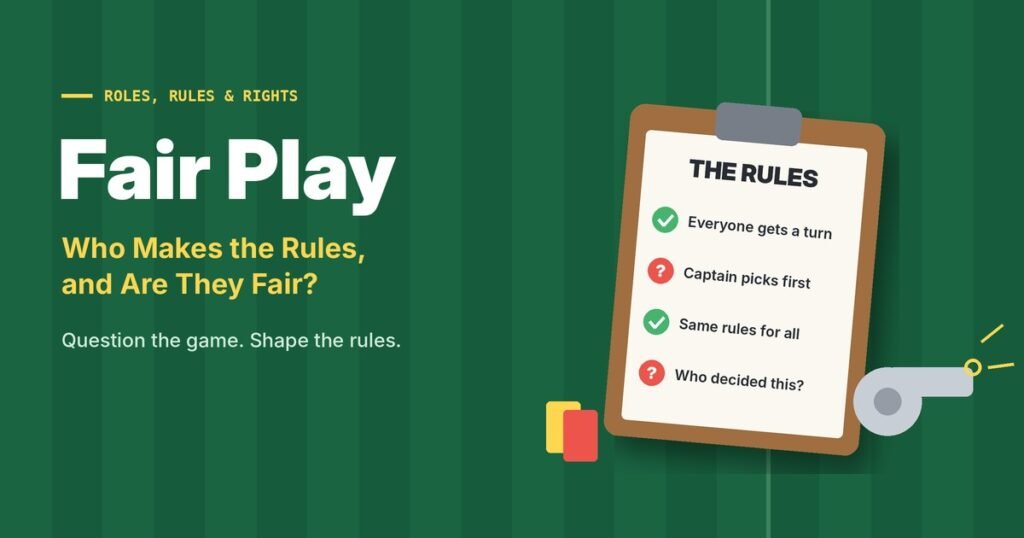
TOPIC: | Fair Play – Who Makes the Rules, and Are They Fair? |
CLASS / DURATION / PREPARED BY: | Grades 7 – 9; 1 lesson; Prepared by: Zita Nichtová, English teacher, ZŠ ŠS Starý Tekov |
LEARNING TASK
Students take part in a realistic school challenge: they investigate rules that may be unfair, decide how to improve them and vote on a new class agreement. They learn that good rules should protect people’s rights, apply fairly and give everyone a chance to express their opinion.
GOALS ACCORDING TO THE GENERAL CURRICULUM
- Understand the importance of fair rules and equal treatment.
- Recognise the difference between equality and fairness.
- Practise democratic decision-making and respectful disagreement.
- Develop critical thinking, collaboration and communication in English.
General Competences
- Civic competence: Participate responsibly in group decisions.
- Critical thinking: Evaluate whether rules are fair and justified.
- Communication: Present arguments, listen to others and negotiate solutions.
Subject Competences
- Use English vocabulary related to fairness, rules, rights and responsibilities.
- Explain why a rule may be fair or unfair.
- Propose a practical solution and justify it with reasons.
Integration with Other Subjects
- Civic Education: Democracy, rights and responsibilities.
- Ethics: Respect, empathy and equal treatment.
- Mathematics: Voting results and interpreting class preferences.
- English: Expressing opinions, agreeing, disagreeing and suggesting changes.
MATERIALS AND EQUIPMENT
Scenario cards, paper and pens, board or interactive whiteboard, voting slips or sticky notes.
LEARNING ACTIVITIES
Activity 1 – The Fairness Test ( 10 min. )
Tell students they are the jury in a school fairness court. Read the following situations and ask them to decide: FAIR, UNFAIR or IT DEPENDS.
Case A: Only the best-performing students are allowed to join a school trip, even when the trip is not connected to academic achievement.
Case B: Every student receives the same amount of time to complete a test, even though one student has an officially approved adjustment allowing extra time.
Case C: A student who repeatedly damages school equipment must help with an appropriate restorative activity and discuss how to prevent further damage.
Case D: A class chooses its representatives by voting, but one student is not allowed to stand as a candidate because they are unpopular.
Students show their decision using fingers (1 = fair, 2 = unfair, 3 = it depends) and explain their reasoning.
Useful English:
- “I think this is unfair because…”
- “Everyone should have the right to…”
- “The rule should apply to…”
- “It depends on the circumstances.”
Teacher’s tip: Encourage different opinions. The goal is not simply to label situations but to explain what makes a decision fair, proportionate and respectful of rights.
Activity 2 – Rewrite the Rules! ( 20 min. )
Divide students into small groups. Each group receives one fictional school rule that needs improvement.
Rule 1: “Only students with excellent marks can represent the school at public events.”
Rule 2: “If one person breaks a rule, the whole class loses its reward.”
Rule 3: “Students are not allowed to question a teacher’s decision.”
Rule 4: “Class representatives are always chosen by the teacher, without asking the students.”
Each group must become a Fair Rules Committee and redesign its rule.
Their new rule must meet four conditions:
- It protects people’s rights.
- It is clear and understandable.
- It applies fairly.
- It includes a way to raise concerns or appeal a decision.
Groups write their original rule, improved rule and a short explanation of why the new version is better.
Example:
Original: “Only students with excellent marks can represent the school at public events.”
Improved: “Students can apply to represent the school. Selection criteria must be clear and relevant to the activity, and all applicants must have an equal opportunity to participate.”
Each group presents its proposal in English. The class can ask one question about each rule.
Activity 3 – Our Class Democracy Challenge ( 15 min. )
Students now put democratic decision-making into practice.
As a class, choose one real, low-risk aspect of classroom life that could be improved, for example:
- How groups are formed for projects.
- How students share responsibilities during group work.
- How everyone gets a chance to speak in discussions.
- How the class resolves disagreements.
In small groups, students suggest one practical rule. Write the proposals on the board and allow each student to vote for their preferred option.
Before voting, agree on three conditions:
- Everyone can express an opinion respectfully.
- The proposals must be realistic and respect school rules.
- The majority vote matters, but the rights of students who disagree must also be respected.
Count the votes and discuss the result. If possible, agree to test the winning idea for one week and review whether it works.
Finish with an individual reflection:
“A fair rule should…, and students should have the right to…”
REFLECTION AND ASSESSMENT
Assess students through their explanations, teamwork, proposed rule changes and participation in the vote.
Reflection questions:
- Does treating everyone equally always mean treating everyone fairly?
- Why should people be allowed to question a decision respectfully?
- What makes a rule legitimate and trustworthy?
Expected Learning Outcomes
By the end of the lesson, students will be able to:
- Identify potential unfairness in everyday rules.
- Explain the difference between equality and fairness.
- Rewrite a rule using clear and inclusive language.
- Participate in a democratic decision-making process.
- Explain why fair procedures and accountability build trust.
Final slogan: “Fair Rules. Equal Voices. Stronger Communities.”