
EDUCATIONAL ACTIVITY PLAN
TOPIC: | Responsible consumption and production: Fast fashion and clothing choices – buy less, wear longer (SDG 12) |
CLASS / DURATION / PREPARED BY: | Grades 8–9; B1 level; 1 lesson (45 minutes); Prepared by: |
LEARNING TASK
After reading two B1-level informational texts, students explain how clothing choices are connected with responsible consumption and production, identify why fast fashion can increase textile waste, and use target vocabulary to discuss ways to keep clothes in use for longer. In pairs, they create a short “Wear It Longer” plan with three realistic actions for students, families, or schools.
GOALS ACCORDING TO THE GENERAL CURRICULUM (2008)
General competences
- Learning to learn: students work purposefully with reading texts, vocabulary and comprehension tasks, compare answers, and reflect on strategies that help them understand sustainability ideas in English.
- Cognitive: they identify cause-and-effect relationships, connect buying habits with textile waste, and select practical ways to extend the life of clothing.
- Social: they cooperate in pairs and groups, listen to different ideas, and agree on realistic actions that support more responsible clothing choices.
- Personal: they take responsibility for their learning and consider how everyday choices about clothes can affect resources, waste and other people involved in production.
Subject competences
- Read B1-level informational texts and identify the main idea, specific details, and cause-and-effect relationships (English).
- Use target vocabulary (fast fashion, textile waste, garment, durable, repair, second-hand, clothing swap, production process) accurately in context (English).
- Explain in simple terms how frequent buying and short use of clothes can increase textile waste and resource use (Environmental science / Technology).
- Connect buying, caring for, repairing and reusing clothes with responsible consumption and production (Citizenship / sustainability).
- Work collaboratively to produce and present a short “Wear It Longer” action plan using clear B1-level English (Communication).
Integration with other subjects
Technology / Environmental science (materials, product life and waste), Geography (where products are made and transported), Civic education (consumer responsibility and fair choices), ICT/Art (optional clothing-care or reuse message).
MATERIALS / EQUIPMENT
Projector/interactive board, photos of a crowded clothing shop and repaired or second-hand clothes, printed reading texts and worksheet (Appendices 1–2), vocabulary cards (optional), dictionaries or phones for quick word checks, paper or a digital template for the pair action plan.
LEARNING ACTIVITIES
(45-minute English lesson; B1 level; technology and sustainability links.)
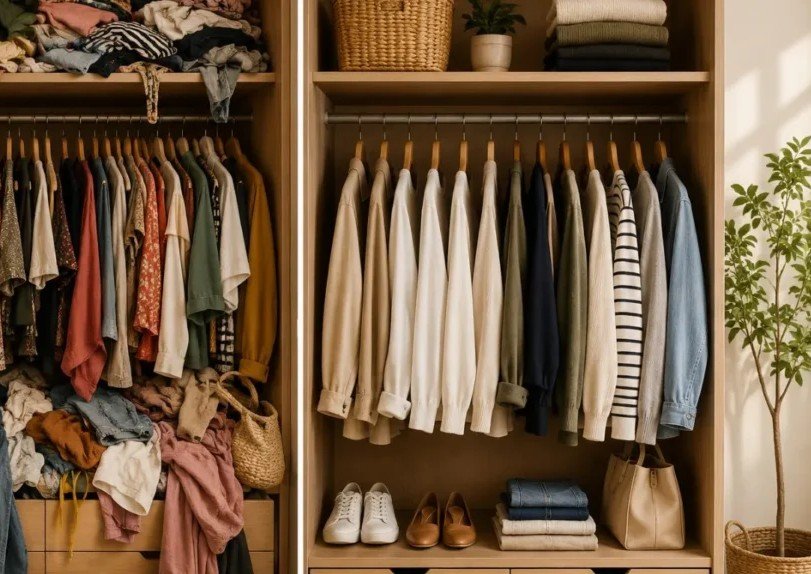
- Warm-up (5 min). Show two contrasting images: a pile of unwanted clothes and a repaired or second-hand garment being used again. Students answer: Why do people replace clothes? What happens to clothes we no longer use? How could we make clothes last longer?
- Pre-reading vocabulary (7 min). Students match the target words with definitions (Appendix 2, Task A). They compare answers in pairs and practise pronunciation.
- Reading & comprehension (17 min). Students read Text A and Text B in Appendix 1, underline causes, effects and responsible choices, and complete True/False and short-answer tasks (Appendix 2, Tasks B–C).
- Language focus (7 min). Students complete short advice sentences using should, could and instead of (Appendix 2, Task D). Quick class check focuses on meaning and B1 sentence structure.
- Speaking & action task (6 min). In pairs, students complete the “Wear It Longer” table (Appendix 2, Task E) and create three realistic actions for students, families or schools. They use at least four target words. A few pairs share one idea. Exit ticket + reflection (Appendix 3).
REFLECTION. ASSESSMENT
Reflection. Students complete their reflection by finishing the sentences:
- In this lesson I learned that clothing choices can affect…
- One new word I can use correctly is…
- One action that can help clothes stay in use longer is…
- Today I did well when… / Next time I will try to…
APPENDIX 1
Reading texts: Responsible consumption and production – fast fashion and clothing choices: buy less, wear longer (SDG 12)
Text A – Why our clothing choices matter
Clothes are part of everyday life, but the way we buy and use them can have environmental effects. Fast fashion describes a system in which new styles are produced quickly and sold at relatively low prices. This can encourage people to buy more garments and replace them after a short time, even when the clothes are still usable.
Every garment goes through a production process. Materials must be produced, the fabric is made, the item is sewn, transported, sold and finally used. Energy, water and other resources are needed at different stages. If clothes are worn only a few times and then thrown away, more new products are needed and textile waste can grow.
Responsible consumption does not mean never buying clothes. It means thinking before buying, choosing items that are useful and durable, and taking care of them so they can be worn for longer.
Table. Clothing situation, possible effect and responsible choice
Clothing situation / pressure | What can happen | Possible impact | Responsible choice |
Clothes are bought often because styles change quickly. | Garments may be used only briefly. | More textile waste and demand for new products. | Pause before buying and choose only useful items. |
A T-shirt has a small tear or missing button. | The garment may be thrown away too early. | A usable item becomes waste. | Repair the damage and keep wearing it. |
Clothes no longer fit but are still usable. | They may stay unworn or be discarded. | Useful garments leave use too soon. | Donate, sell second-hand or join a clothing swap. |
Very cheap clothing is chosen only because of price. | The item may not last as long as needed. | It may need replacing sooner. | Choose durable items that suit a real need. |
People do not think about how clothing is made. | The production process stays invisible. | Resource use and waste are easier to ignore. | Learn about product origin and buy thoughtfully. |
A school wants to reduce clothing waste. | Students may not know reuse options. | Usable clothes can become textile waste. | Organise repair, donation or clothing-swap activities. |
Text B – Giving clothes a longer life
One of the simplest ways to reduce textile waste is to keep clothes in use for longer. A small tear or missing button does not always mean a garment must be replaced. People can repair simple damage, follow care instructions and use clothes until they are truly worn out. Choosing durable clothing can also reduce the need to replace items quickly.
Clothes that no longer fit or are no longer wanted can still be useful to someone else. Buying or selling second-hand clothes, donating items in good condition, or joining a clothing swap can give garments another user instead of sending them directly to waste.
Schools and families can support these habits by organising swap events, repair activities or awareness campaigns. When consumers buy less, choose carefully, repair what they can and reuse clothing, they reduce waste and support more responsible consumption and production.
Read both texts and complete the vocabulary, comprehension, advice-language and action tasks in Appendix 2.
APPENDIX 2
Student worksheet (English, B1)
- Task A – Vocabulary (match). Match the words to the definitions.
Words: fast fashion, textile waste, garment, durable, repair, second-hand, clothing swap, production process.
Definitions: a) clothes or fabric materials that are thrown away; b) a piece of clothing; c) made to last for a long time; d) to fix something so it can be used again; e) used or owned by another person before; f) an event where people exchange clothes they no longer need; g) the stages involved in making a product; h) a system in which new clothing styles are produced quickly and sold cheaply. - Task B – True / False. Read the texts again. Decide if the statements are True or False and correct the false ones.
1) Fast fashion can encourage people to buy clothes more often.
2) A garment uses no resources before it reaches a shop.
3) Repairing small damage can help clothes stay in use longer.
4) Second-hand clothes must always be thrown away quickly.
5) A clothing swap can help reduce textile waste. - Task C – Reading comprehension. Answer in complete B1-level sentences.
1) Why can fast fashion increase textile waste?
2) Name two stages in the production process of a garment.
3) Give two ways to make clothes last longer.
4) How can schools or families encourage more responsible clothing choices? - Task D – Advice language. Complete each sentence with should, could or instead of.
1) We ______ check whether we really need a new garment before buying it.
2) Students ______ organise a clothing swap at school.
3) People can repair a small tear ______ throwing the garment away.
4) We ______ choose durable clothes that we can wear many times.
5) Families ______ donate or sell usable clothes that no longer fit.
Task E – “Wear It Longer” action plan. Complete the table, then choose three actions that students, families or schools could realistically take.
Situation | What is the problem? | Target word to use | Better action |
A student wants a new jacket even though the old one still fits. | The new purchase may not be necessary. | fast fashion / durable / garment |
|
A favourite shirt has a small hole. | The garment could be discarded even though it can still be used. | repair / garment / durable |
|
A class has many clothes that students no longer wear. | Usable clothes may become textile waste. | second-hand / clothing swap / textile waste |
|
APPENDIX 3
Assessment criteria (10 points)
Explain the criteria to students before the tasks (what is expected and what each point represents).
- Reading comprehension (Tasks B–C) – up to 4 points.
- Vocabulary and language accuracy (Tasks A and D + use of target words in Task E) – up to 4 points.
- Pair action plan + participation + reflection/exit ticket – up to 2 points.