

EDUCATIONAL ACTIVITY PLAN
TOPIC: | Responsible consumption and production: Food waste and smart food choices – plan, store, share (SDG 12) |
CLASS / DURATION / PREPARED BY: | Grades 8–9; B1 level; 1 lesson (45 minutes); Prepared by: |
LEARNING TASK
After reading two B1-level informational texts, students explain how everyday food choices are connected with responsible consumption and production, identify common causes and effects of food waste, and use target vocabulary to suggest realistic ways to plan, store, share and use food more responsibly.
GOALS ACCORDING TO THE GENERAL CURRICULUM (2008)
General competences
- Learning to learn: students work purposefully with reading texts, vocabulary and comprehension tasks, compare answers, and reflect on strategies that help them understand sustainability ideas in English.
- Cognitive: they identify cause-and-effect relationships, connect shopping, portions and food storage with food waste, and select practical ways to prevent edible food from being discarded.
- Social: they cooperate in pairs and groups, listen to different ideas, and agree on realistic actions that support more responsible food consumption.
- Personal: they take responsibility for their learning and consider how everyday decisions about buying, storing and using food can affect resources, waste and the wider community.
Subject competences
- Read B1-level informational texts and identify the main idea, specific details, and cause-and-effect relationships (English).
- Use target vocabulary (food waste, leftovers, portion, meal plan, food storage, best-before date, food donation, compost) accurately in context (English).
- Explain in simple terms why edible food is wasted and how food waste also means wasting resources used to grow, process, transport and prepare food (Environmental science / Technology).
- Connect meal planning, suitable portions, correct storage, using leftovers, organised donation and composting with responsible consumption and production (Citizenship / sustainability).
- Work collaboratively to produce and present a short “Save Food” action plan using clear B1-level English (Communication).
Integration with other subjects
Biology / Environmental science (food, decomposition and resource use), Technology (food preparation and storage), Geography (food supply chains and transport), Civic education (responsible consumption and community support), ICT/Art (optional digital poster or awareness message).
MATERIALS / EQUIPMENT
Projector/interactive board, photos of edible food being thrown away and leftovers being reused, printed reading texts and worksheet (Appendices 1–2), vocabulary cards (optional), dictionaries or phones/tablets for checking unfamiliar words if allowed.
LEARNING ACTIVITIES
(45-minute English lesson; B1 level; environmental science and sustainability links.)
- Warm-up (5 min). Show two contrasting images: edible food being thrown into a bin and a meal made from leftovers. Students answer: Why is food sometimes wasted? What could people do before throwing food away? Collect 3–4 ideas on the board.
- Pre-reading vocabulary (7 min). Students match the target words with definitions (Appendix 2, Task A). They compare answers in pairs and practise pronunciation.
- Reading & comprehension (17 min). Students read Text A and Text B in Appendix 1, underline causes, effects and responsible choices, and complete True/False and short-answer tasks (Appendix 2, Tasks B–C). Pair-check, then brief class feedback.
- Language focus (7 min). Students complete short advice sentences using should, shouldn’t and can (Appendix 2, Task D). Quick class check focuses on meaning and B1 sentence structure.
- Speaking & action task (6 min). In pairs, students complete the “Save Food” table (Appendix 2, Task E) and create three realistic actions for students, families or schools. They use at least four target words. Two or three pairs share one idea with the class.
REFLECTION. ASSESSMENT
Reflection (3 min). Students complete their reflection by finishing the sentences:
- In this lesson I learned that food waste can affect…
- One new word I can use correctly is…
- One action that can help prevent food waste is…
- Today I did well when… / Next time I will try to…
APPENDIX 1
Reading texts: Responsible consumption and production – food waste and smart food choices: plan, store, share (SDG 12)
Text A – Why good food becomes waste
Food waste happens when food that could have been eaten is thrown away. This often happens because people buy too much, prepare portions that are too large, forget food in the fridge or misunderstand date labels. Leftovers may also be discarded even when they could safely become another meal.
Wasting food also wastes resources. Growing, processing, transporting and cooking food use water, land, energy and human work. A simple meal plan can help people check what they already have and buy only what they are likely to use. Choosing a suitable portion can also reduce uneaten food.
A best-before date is mainly connected with expected product quality. It does not automatically mean that food becomes waste on that exact day. People should still follow storage instructions and check food carefully.
Table. Food situation, possible effect and responsible choice
Food situation / pressure | What can happen | Possible impact | Responsible choice |
Shopping without checking food at home. | Food is forgotten. | Extra food may become waste. | Make a meal plan and shopping list. |
Taking a very large portion. | Food remains uneaten. | Edible food is discarded. | Start with a suitable portion. |
Cooked food remains after dinner. | Leftovers may be thrown away. | Useful food is wasted. | Store safely and use in another meal. |
Food is stored incorrectly. | It may spoil sooner. | More food waste is created. | Follow storage instructions. |
A product reaches its best-before date. | It may be thrown away automatically. | Usable food may be discarded. | Check it carefully before deciding. |
Safe surplus food cannot be used. | It may be discarded. | Food and resources are wasted. | Use organised food donation when suitable. |
Text B – Plan, store, share and use more
Small habits can help food stay useful for longer. Good food storage is important: some foods need refrigeration, while others should be kept dry or covered. Keeping the fridge organised can make older food easier to see and use first. Leftovers can often be saved for the next meal or turned into a different dish, for example vegetables in soup or cooked rice in a new meal.
When safe, unopened or surplus food cannot be used by the original owner, organised food donation programmes can help it reach people who need it. Schools and communities can also share information about reducing food waste and planning sensible portions.
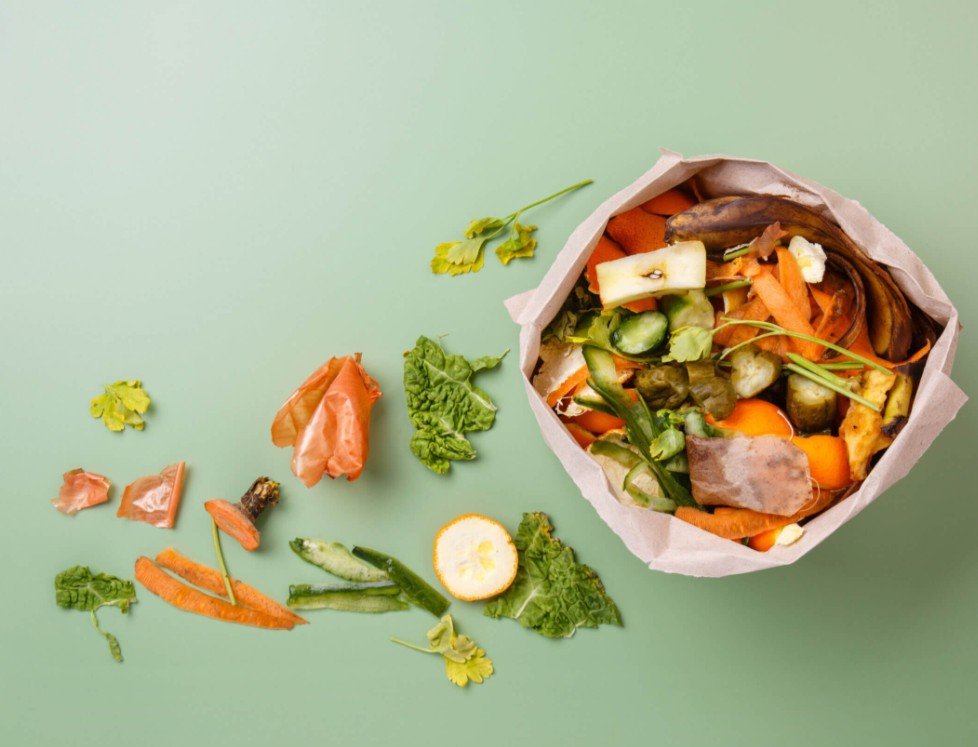
Not every part of food can be eaten. Peels, damaged leaves and other unavoidable food scraps may sometimes be suitable for compost. Composting returns organic material to the soil instead of sending it to general waste. The best order is to prevent waste first, use edible food as fully as possible, share safe surplus food when appropriate, and compost unavoidable scraps.
Read both texts and complete the vocabulary, comprehension, advice-language and action tasks in Appendix 2.
APPENDIX 2
Student worksheet (English, B1)
- Task A – Vocabulary (match). Match the words to the definitions.
Words: food waste, leftovers, portion, meal plan, food storage, best-before date, food donation, compost.
Definitions: a) food that remains after a meal; b) a plan of meals for several days; c) food that could have been eaten but is discarded; d) the amount of food served to one person; e) keeping food in suitable conditions so it stays usable; f) a date mainly connected with expected product quality; g) organised giving of safe surplus food to others; h) decayed organic material that can improve soil. - Task B – True / False. Read the texts again. Decide if the statements are True or False and correct the false ones.
1) Food waste can happen because people buy more than they need.
2) Throwing away edible food wastes only the food and no other resources.
3) A meal plan can help people avoid unnecessary purchases.
4) Leftovers can never be used for another meal.
5) Good food storage can help food stay useful for longer.
6) Composting is one possible option for some unavoidable food scraps. - Task C – Reading comprehension. Answer in complete B1-level sentences.
1) Give three reasons why edible food may be wasted.
2) Name three resources connected with producing and preparing food.
3) How can a meal plan help reduce food waste?
4) Give two ways to use leftovers responsibly.
5) When can food donation be useful?
6) Why is prevention better than throwing food away and dealing with it later? - Task D – Advice language. Complete each sentence with should, shouldn’t or can.
1) We ______ check what food we already have before shopping.
2) People ______ buy much more food than they expect to use.
3) Leftovers ______ become part of another meal.
4) Food ______ be stored according to the instructions.
5) Schools ______ share practical ideas for reducing food waste.
6) Unavoidable food scraps ______ sometimes be composted.
Task E – “Save Food” action plan. Complete the table, then choose three actions that students, families or schools could realistically take.
Situation | What is the problem? | Target word to use | Better action |
A student buys snacks without checking what is already in the school bag. | Food may be bought twice and left unused. | meal plan / food waste / portion |
|
A family has cooked vegetables left after dinner. | The leftovers may be thrown away even though they can still be used. | leftovers / food storage / food waste |
|
A school event has safe unopened food remaining. | Useful food could be discarded. | food donation / food waste / compost |
|
APPENDIX 3
Assessment criteria (10 points)
Explain the criteria to students before the tasks (what is expected and what each point represents).
- Reading comprehension (Tasks B–C) – up to 4 points.
- Vocabulary and language accuracy (Tasks A and D + use of target words in Task E) – up to 4 points.
- Pair action plan + participation + reflection/exit ticket – up to 2 points.