
EDUCATIONAL ACTIVITY PLAN
TOPIC: | Life below water: Plastic pollution – from land to sea (SDG 14) |
CLASS / DURATION / PREPARED BY: | Grades 8–9; B1 level; 1 lesson (45 minutes); Prepared by: |
LEARNING TASK
After reading two B1-level informational texts, students identify how plastic waste travels from land to the ocean, explain its effects on marine life, and use target vocabulary to suggest ways of stopping pollution before it reaches the sea. In pairs, they create a short “Stop It at the Source” action plan with three realistic actions for school, home, or the local community.
GOALS ACCORDING TO THE GENERAL CURRICULUM (2008)
General competences
- Learning to learn: students work purposefully with a reading text, vocabulary and comprehension tasks, check their answers, and reflect on which strategies helped them understand new language.
- Cognitive: they identify cause-and-effect links, compare pollution pathways, and choose suitable solutions based on information in the texts.
- Social: they cooperate in pairs and groups, listen to different ideas, and agree on realistic actions that can reduce plastic pollution.
- Personal: they take responsibility for their learning and consider how everyday choices can affect rivers, seas and marine life.
Subject competences
- Read B1-level informational texts and identify the main idea, specific details, and cause-and-effect relationships (English).
- Use target vocabulary (litter, storm drain, runoff, wastewater, single-use plastic, microplastics, reusable, prevention) accurately in context (English).
- Explain in simple terms how land-based waste can reach marine ecosystems and why small plastic particles are difficult to remove (Environmental science).
- Connect everyday actions with environmental consequences and suggest realistic ways to prevent plastic pollution (Citizenship / sustainability).
- Work collaboratively to produce and present a short “Stop It at the Source” action plan using clear B1-level English (Communication).
Integration with other subjects
Environmental science / Biology (marine pollution and food chains), Geography (rivers and water movement), Civic education (responsible choices), ICT/Art (optional digital action message).
MATERIALS / EQUIPMENT
Projector/interactive board, photos of street litter, rivers and beaches, printed reading texts and worksheet (Appendices 1–2), vocabulary cards (optional), dictionaries or phones for quick word checks, paper or a digital template for the pair action plan.
LEARNING ACTIVITIES
(45-minute English lesson; B1 level; environmental science links.)
- Warm-up (5 min). Show two contrasting images: a clean riverbank and a littered street after rain. Students answer: Where can this rubbish go next? Can waste from a street reach the sea?
- Pre-reading vocabulary (7 min). Students match the target words with definitions (Appendix 2, Task A). They compare answers in pairs and practise pronunciation.
- Reading & comprehension (17 min). Students read Text A and Text B in Appendix 1, underline the different pathways by which plastic reaches water, and complete True/False and short-answer tasks (Appendix 2, Tasks B–C).
- Language focus (7 min). Students complete B1 word-order sentences about causes and solutions (Appendix 2, Task D). Quick class check focuses on word order and the use of can/should.
- Speaking & action task (6 min). In pairs, students complete the “Stop It at the Source” table (Appendix 2, Task E) and create three practical actions for school, home or the community. They use at least four target words. A few pairs share one idea. Exit ticket + reflection (Appendix 3).
REFLECTION. ASSESSMENT
Reflection. Students complete their reflection by finishing the sentences:
- In this lesson I learned that plastic can reach the ocean when…
- One new word I can use correctly is…
- One action that could prevent plastic pollution is…
- Today I did well when… / Next time I will try to…
APPENDIX 1
Reading texts: Plastic pollution – from land to sea (SDG 14)
Text A – How does plastic reach the ocean?
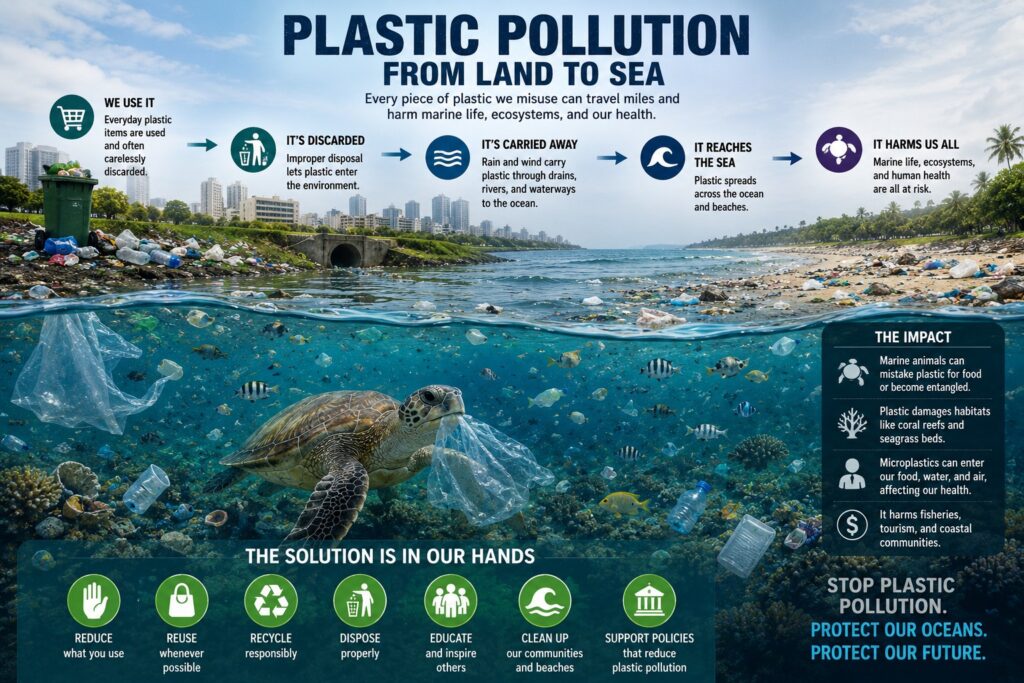
A plastic bottle dropped far from the coast can still become ocean pollution. On windy days, light packaging and bags can be blown from streets and parks into streams or rivers. During heavy rain, water flows over roads and carries litter with it. This moving water is called runoff. In many towns, runoff enters a storm drain and then travels through pipes to a river. Some storm drains lead directly to natural waterways, so rubbish on the street may travel much farther than people expect.
Plastic can also enter water through wastewater. Tiny fibres can come off synthetic clothes when they are washed. Some treatment systems remove many particles, but very small pieces may still pass through. Larger plastic items break into smaller and smaller pieces over time. When they become less than about five millimetres in size, they are called microplastics. These particles are difficult to collect once they spread through rivers and seas.
The problem is not only the plastic we can see. Fish, seabirds and other animals may mistake small pieces for food. Plastic can also move through food chains. This is why preventing waste before it reaches water is usually easier than trying to remove it later.
Table. How plastic moves from land to water
Source / pathway | How plastic moves | Possible impact | Prevention idea |
Street litter | Wind or rain moves rubbish into drains and streams. | Plastic enters rivers and may travel to the sea. | Use closed bins; keep school grounds and streets litter-free. |
Storm drains | Runoff carries litter into drains after rain. | Waste can reach waterways quickly. | Keep drains clear; place bins near litter hotspots. |
Rivers and streams | Floating plastic is carried downstream. | Animals may swallow or become trapped in plastic. | Organise riverbank clean-ups and prevent litter upstream. |
Wastewater | Very small fibres and particles can travel with used water. | Microplastics spread and are difficult to remove. | Reduce unnecessary fibre loss; use full washing loads. |
Single-use packaging | Used items become waste after a short time. | More plastic enters the waste stream. | Choose reusable bottles, lunch boxes and bags. |
Beach / picnic waste | Light items can be blown or washed into the sea. | Direct pollution of coastal habitats. | Take all waste home or use secure bins. |
Text B – Stop pollution before it starts
Cleaning beaches is useful, but prevention can have a bigger effect. One important step is to reduce single-use plastic: items designed to be used once and thrown away, such as some cups, bags, straws and food containers. Choosing a reusable bottle, lunch box or shopping bag can reduce the amount of waste produced each day.
Correct disposal also matters. Rubbish placed in a closed bin is less likely to be carried away by wind or rain. Schools can label bins clearly and check areas near entrances, sports fields and bus stops, where litter often collects. Communities can organise riverbank clean-ups, but they can also look for the source of the waste. If litter repeatedly appears near a storm drain, a better bin location or an information sign may help prevent the problem.
People can also reduce microplastic pollution. Washing synthetic clothes less often, using full loads and choosing long-lasting products can reduce unnecessary fibre loss. No single action will solve the problem, but many small choices can reduce the amount of plastic that reaches rivers and oceans. Protecting life below water begins on land.
Read both texts and complete the vocabulary, comprehension, word-order and action tasks in Appendix 2.
APPENDIX 2
Student worksheet (English, B1)
- Task A – Vocabulary (match). Match the words to the definitions.
Words: litter, storm drain, runoff, wastewater, single-use plastic, microplastics, reusable, prevention.
Definitions: a) water that has been used in homes or buildings; b) stopping a problem before it happens; c) rubbish left in the wrong place; d) water flowing over the ground after rain; e) a drain that carries rainwater away from streets; f) designed to be used many times; g) plastic items designed to be used once; h) very small plastic particles. - Task B – True / False. Read the texts again. Decide if the statements are True or False and correct the false ones.
1) Plastic dropped on a street can never reach the ocean.
2) Runoff can carry litter into storm drains and rivers.
3) Microplastics are easier to collect than large plastic items.
4) Reusable items can help reduce the amount of single-use plastic waste.
5) Prevention means only cleaning beaches after plastic arrives there. - Task C – Reading comprehension. Answer in complete B1-level sentences.
1) Give two ways plastic from land can reach a river or sea.
2) Why are microplastics difficult to remove from the environment?
3) Why can moving a bin or adding a sign near a storm drain be useful?
4) Give two everyday actions from Text B that can reduce plastic pollution. - Task D – Word order. Put the words in the correct order to make sentences.
1) can / rain / litter / into rivers / carry
2) should / reusable / students / bottles / use
3) microplastics / difficult / are / to remove
4) prevention / pollution / can / reduce / plastic
5) a storm drain / water / carries / from streets / away
Task E – “Stop It at the Source” action plan. Complete the table, then choose three actions your school or community could realistically do.
Problem place | What happens | Target word to use | Better action |
School entrance after rain | Cups and wrappers collect near a drain. | storm drain / runoff |
|
Lunch area | Many disposable bottles and packages are used. | single-use plastic / reusable |
|
Local riverbank | Litter is found after weekends. | litter / prevention |
|
APPENDIX 3
Assessment criteria (10 points)
Explain the criteria to students before the tasks (what is expected and what each point represents).
- Reading comprehension (Tasks B–C) – up to 4 points.
- Vocabulary and language accuracy (Tasks A and D + use of target words in Task E) – up to 4 points.
- Pair action plan + participation + reflection/exit ticket – up to 2 points.