EDUCATIONAL ACTIVITY PLAN
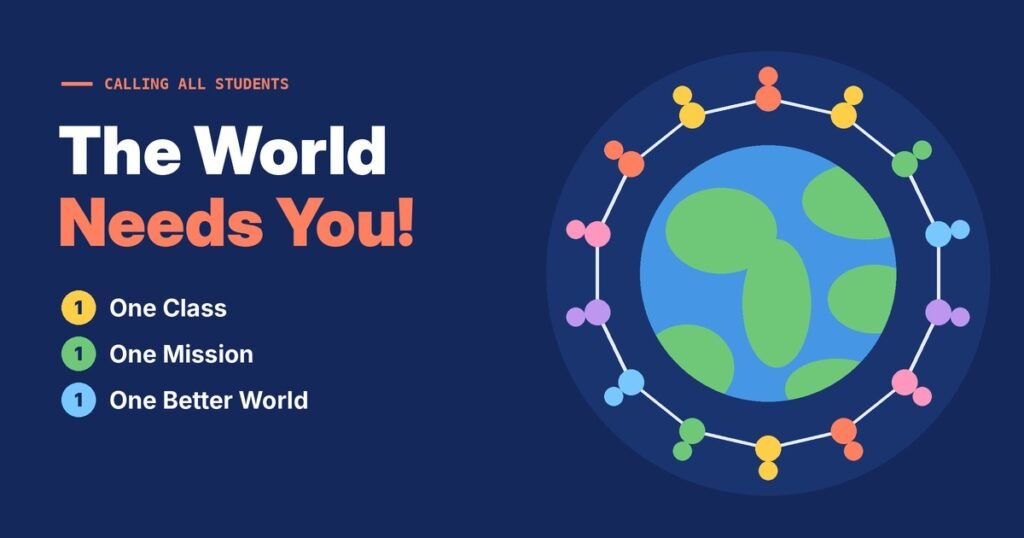
TOPIC: | The World Needs You! – One Class, One Mission, One Better World |
CLASS / DURATION / PREPARED BY: | Grades 8; 1 lesson; Prepared by: Zita Nichtová, English teacher, ZŠ ŠS Starý Tekov |
LEARNING TASK
Students take part in an inspiring “Better World Challenge”. They discover that many global problems cannot be solved by one person, school or country alone. Working in international teams, they receive a mission to make the world a little better and must combine their skills, ideas and resources to achieve their goal.
The lesson ends with a shared class commitment and a positive message: young people do not have to wait until they are adults to make a difference.
GOALS ACCORDING TO THE GENERAL CURRICULUM
- Understand why partnerships are essential for achieving the Sustainable Development Goals.
- Recognise the value of cooperation between individuals, schools, communities, organisations and countries.
- Develop empathy, creativity, critical thinking and responsible citizenship.
- Design a realistic collaborative action that can create positive change.
General Competences
- Social and civic competence: Understand shared responsibility and contribute to the community.
- Communication: Express opinions, negotiate and present ideas in English.
- Initiative and cooperation: Develop a shared solution and take responsibility for a common goal.
Subject Competences
- Use English vocabulary related to partnerships, global challenges, solidarity and sustainability.
- Explain how cooperation between different partners can solve a problem.
- Present a practical action plan and justify its expected impact.
Integration with Other Subjects
- Civic Education: Global citizenship, solidarity and participation.
- Geography: Global challenges and international cooperation.
- Ethics: Empathy, respect and responsibility.
- English: Collaboration, persuasive speaking and presenting proposals.
- Informatics: Sharing project results through the Virtual Learning Centre.
MATERIALS AND EQUIPMENT
Mission cards, paper, pens and sticky notes, large sheet of paper per group, board or interactive whiteboard, optional: coloured markers
LEARNING ACTIVITIES
Activity 1 – If You Could Change One Thing… ( 8 min. )
Begin with a simple question:
“Imagine that tomorrow you wake up in a world that is a little better than today. What has changed?”
Give students one minute to think individually. Ask them to write their answer on a sticky note without adding their names.
Possible answers might include:
- Nobody feels lonely or excluded.
- Children everywhere have access to education.
- People help each other instead of fighting.
- Nature is cleaner and better protected.
- Everyone has access to safe drinking water.
- People are treated fairly, regardless of their background.
Read several answers aloud and group similar ideas together.
Then ask:
- Can one person make this change happen alone?
- Who else would need to help?
- What could teenagers contribute?
Introduce the central idea of SDG 17: Partnerships help turn good intentions into real results.
Useful English:
- “I would change… because…”
- “We would need help from…”
- “Young people can contribute by…”
Teacher’s message: We may not be able to solve every problem, but we can choose to be part of the solution.
Activity 2 – The Better World Mission ( 22 min. )
Divide the class into teams of four or five. Tell them:
“You are a youth team invited to join an international partnership. Your team has one week, a small budget and a network of possible partners. Your mission is to create a project that makes a real positive difference.”
Each group chooses one mission card.
MISSION A – Nobody Left Behind
Create an initiative that helps young people feel welcome, included and supported.
MISSION B – Our Planet, Our Responsibility
Design a project that encourages people to protect nature and reduce waste.
MISSION C – Knowledge Has No Borders
Create a way for young people from different schools or countries to share knowledge, traditions, languages or useful skills.
MISSION D – Kindness Goes Viral
Develop a positive campaign that inspires people to help others through small, achievable actions.
Each team must create a Better World Action Plan with five parts:
- THE PROBLEM: What do we want to improve?
- OUR IDEA: What exactly will we do?
- OUR PARTNERS: Who can help us? Include at least three different partners, such as students, teachers, families, a local organisation, a library or an international partner school.
- EVERYONE MATTERS: What will each partner contribute?
- OUR IMPACT: How will we know that we have made a difference?
Add one special challenge: the project must be realistic enough to start in the students’ own school or community.
Example – Knowledge Has No Borders
- Students from two partner schools exchange short videos about their everyday lives.
- Each school teaches the other five useful words or phrases in its language.
- Pupils create a shared online guide called “What We Can Learn from Each Other.”
- Teachers help coordinate the exchange, and students collect feedback to see what they learned.
English phrases:
- “Our goal is to…”
- “We would like to work with…”
- “Each partner could contribute…”
- “This project would make a difference because…”
- “We could measure our success by…”
Teacher’s tip: Encourage meaningful ideas rather than impressive-sounding promises. A small project with real participants and a clear result is better than a huge plan nobody can carry out.
Activity 3 – The Better World Summit ( 15 min. )
Transform the classroom into an international youth summit. Each team has one minute to present its action plan to the other teams.
Their presentation must explain:
- What problem they want to solve.
- What their project will do.
- Who their partners are.
- Why cooperation is necessary.
- What positive result they hope to achieve.
After each presentation, the audience gives one positive comment and one practical suggestion.
The final challenge: Create the Class Partnership Pledge.
As a whole class, agree on three commitments that you can genuinely follow. For example:
- We will listen to and respect different ideas.
- We will share our skills and help others participate.
- We will complete one small project together instead of only talking about it.
Write the three commitments on a large sheet of paper. Each student signs it or adds a personal promise.
Finish with this question:
“What is one thing you can do this week that could inspire someone else to do something good?”
Invite volunteers to share their answers.
Closing message for students:
“The world does not become better only because people talk about change. It becomes better when people work together, take responsibility and turn their ideas into action. You are never too young to be part of that change.”
REFLECTION AND ASSESSMENT
Assess students through their participation, the quality of their partnership plan, their ability to identify different contributions and their understanding of how to measure impact.
Reflection questions:
- Why are partnerships important when solving global problems?
- What can a young person contribute to a project even without money or special resources?
- How can we make sure that a partnership benefits everyone involved?
- What is the difference between having a good idea and making a real difference?
Expected Learning Outcomes
By the end of the lesson, students will be able to:
- Explain the importance of partnerships in achieving shared goals.
- Identify suitable partners for a community or global project.
- Design a realistic action plan with shared responsibilities.
- Present and justify a collaborative idea in English.
- Identify one practical action they can take with others.
Our Final Message: “Small Actions. Shared Dreams. One Better World.”
We don’t have to do everything. We just have to do something — together.